Global Model Updates
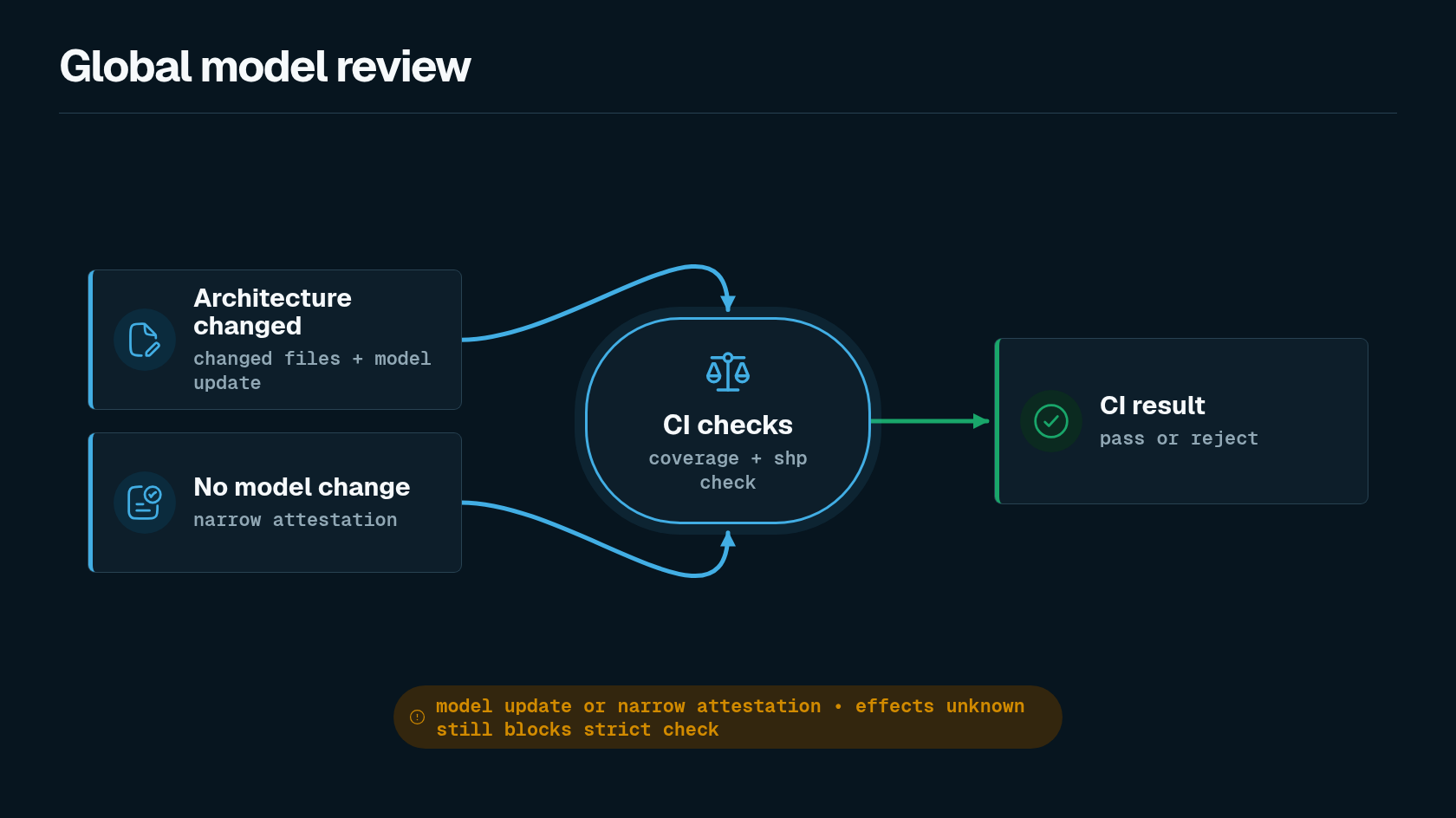
Architecture claims belong in shape/**/*.shape. The checker loads those files as one global model. This page covers how to update that model when source behavior changes, when to use effects unknown, and when a narrow attestation is enough.
If an architecture change is not ready to be checked, keep it outside shape/. Any file under shape/ is part of the checked model.
When this applies
Section titled “When this applies”- Governed source paths change behavior that the Shape model describes
- You add or remove functions, effects, relations, rules, or design memory
- A change does not alter architecture and needs a current
attest no_shape_change
Coverage answers whether a governed path was documented in the current change set. Semantic check answers whether the committed model is coherent. Both matter.
Edit the owning global file
Section titled “Edit the owning global file”When source changes alter architecture, edit the owning global .shape file directly. Keep the module complete and checkable. Example: a purge path that claims hard-delete (this fails under prelude AppendOnly; that failure is intentional when teaching final forbids):
module audit
resource AuditEvent : AppendOnly
component AuditStore {  owns AuditEvent  grants Append<AuditEvent>  grants HardDelete<AuditEvent>  grants Read<AuditEvent>  fn purgeOldEvents    source ts("src/audit/purge.ts#purgeOldEvents")    effects complete {      HardDelete<AuditEvent>        evidence ts("src/audit/purge.ts#purgeOldEvents")    }}
The checker evaluates the model as committed. Coverage then requires that changed governed source paths have a current .shape source or evidence reference, or a current attestation, in a .shape file that is also part of the change set. See Implementations and Coverage and Model Updates and Attestations.
Update checklist
Section titled “Update checklist”- Find the component, resource, implementation, relation, rule, or memory that describes the changed behavior.
- Edit the global
.shapefile undershape/so claims match the intended architecture contract. - Add source and evidence refs for material effects.
- Use
effects unknownonly while uncertainty remains; do not leave empty complete summaries. - Add a
reevaluationwhen changing a guarded function shape that requires one. - Format and check:
git diff --name-only origin/main...HEAD > changed.txtshp fmt --checkshp check --changed-files changed.txtshp check --changed-files runs semantic checks plus coverage and bindings. You can also run shp coverage --changed-files changed.txt separately.
Draft unknowns
Section titled “Draft unknowns”Authoring helpers and incomplete analysis often produce effects unknown. That is the correct conservative claim until effects are known. Strict shp check rejects unknowns so they cannot ship as if they were resolved.
Validate a draft without weakening other rules:
shp check --allow-unknown-effects draft.shapeUnknown effects become warnings. Final forbids, missing grants for known effects, guarded-change obligations, coverage, bindings, and malformed structure remain blocking. Resolve every unknown and run strict shp check before committing the model or using it in CI.
module audit
resource AuditEvent : AppendOnly
component AuditStore {  owns AuditEvent  fn importLegacyEvents    source ts("src/audit/import.ts#importLegacyEvents")    effects unknown}
Attestation path
Section titled “Attestation path”If a governed source change does not alter the architecture model, add a narrow attestation in a .shape file that is part of the same change set:
module audit
attest no_shape_change {  source ts("src/audit/reporting.ts")  reason "Formatting-only change; no resource access or effect changed."}
Attestations are current-change evidence. A previously committed attestation does not waive a future source change unless the declaring .shape file is changed again with a current attestation for that change.
Bindings can use similar attestations (for example docs_not_needed when docs coupling is declared). Point the attestation at the triggering path, give a concrete reason, and keep it in a changed .shape file.
Guarded function shapes
Section titled “Guarded function shapes”Refactor-sensitive or otherwise guarded functions can require memory and, when the shape changes, a matching reevaluation. A source-path attestation does not satisfy that obligation. Coverage documents that a governed path was acknowledged; reevaluation documents that a guarded shape change was reviewed. See Refactor Constraints.
Best practices
Section titled “Best practices”Do
- Prefer one coherent global model under
shape/over ad-hoc sidecar models for the same contract - Keep attestations narrow, path-specific, and current
- Use
effects unknownduring draft; require complete summaries for protected paths before merge - Run
shp obligationsandshp memorywhen editing guarded targets
Do not
- Commit incomplete modules that reference undeclared resources or effects
- Rely on an old attestation for a new change set
- Use
--allow-unknown-effectsin CI as a permanent gate - Expect memory or reevaluation to override a
forbid final