Refactor Constraints
Refactor constraints let Shape record why a function shape should not be changed casually. They are useful when the risky part of the architecture is not only an effect like HardDelete<AuditEvent>, but the local structure of a function: inline checks, error ordering, compatibility code, or a test-only helper that looks production-shaped.
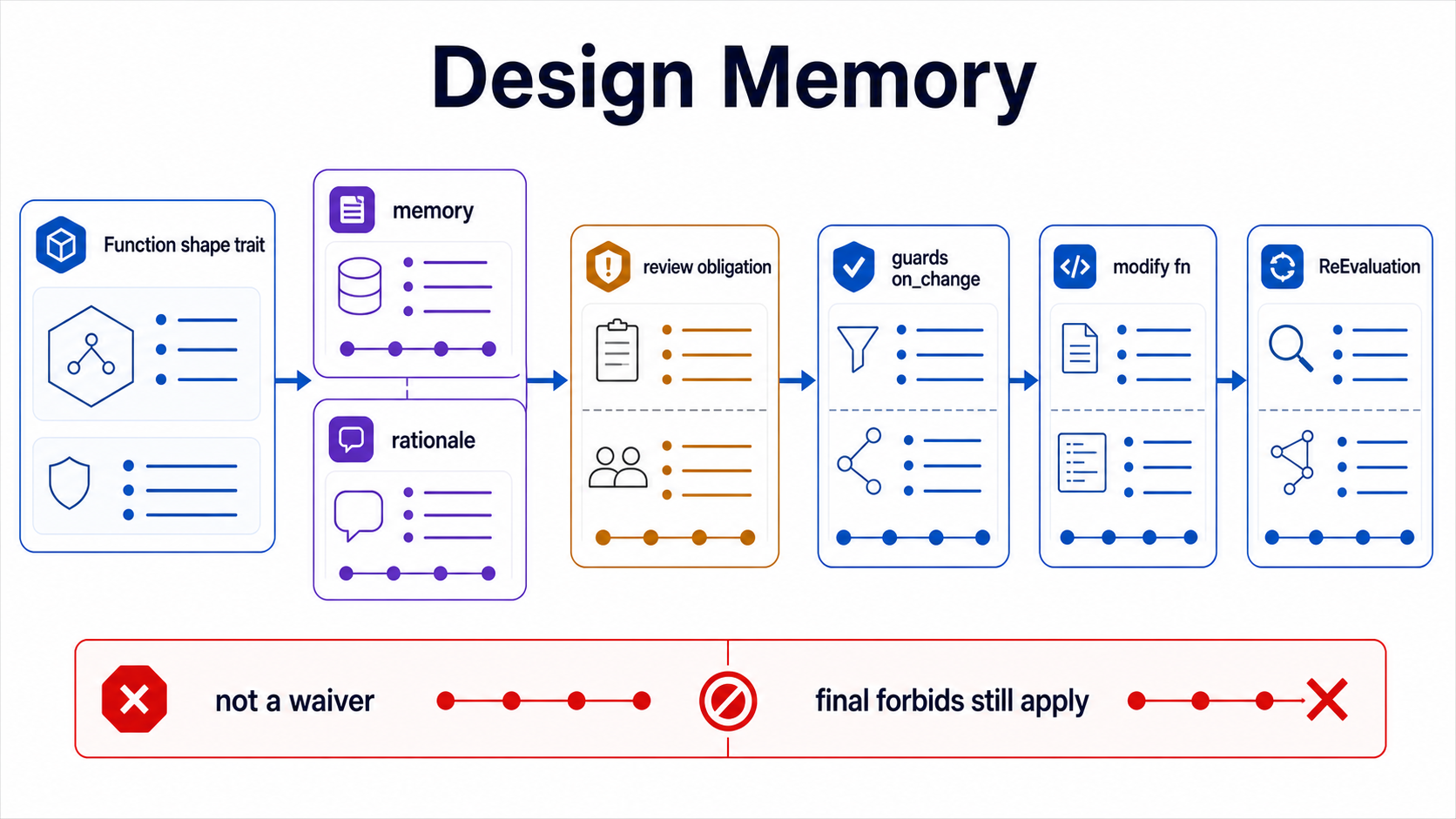
The checker treats this as design memory with types. A function shape trait creates an obligation, a rationale or memory satisfies that obligation, and a guarded change requires a reevaluation.
Refactor constraints are not waivers. They cannot make a final-forbidden effect pass.
Function Shape Traits
Section titled “Function Shape Traits”Function shape traits attach review obligations to a function summary:
| Trait | Required context |
|---|---|
PreserveInline | InlineRationale<fn Component.fn> from a rationale |
RequiresDescription | non-empty description plus DescriptionRationale<fn Component.fn> |
ProtectedCheckOrder | CheckOrderRationale<fn Component.fn> from a rationale or memory |
RefactorSensitive | RefactorConstraint<fn Component.fn> from a memory |
NonIdiomatic | DesignRationale<fn Component.fn> from a rationale or memory |
TestOnly | TestOnlyPurpose<fn Component.fn> from a rationale |
For example, this model says reviewers must see why derivePolicyDecision stays inline:
module gateway
resource PolicySnapshot
component Gateway {  owns PolicySnapshot  grants Read<PolicySnapshot>  fn derivePolicyDecision : PreserveInline    effects complete {      Read<PolicySnapshot>    }}
rationale DerivePolicyDecisionInline : InlineRationale<fn Gateway.derivePolicyDecision> {  applies_to fn Gateway.derivePolicyDecision  why CognitiveLocality  summary "Policy checks remain inline so reviewers can inspect the authorization path locally."  who { owner GatewayTeam }}
Component and Resource Shape Traits
Section titled “Component and Resource Shape Traits”Shape traits are not limited to functions. Components and resources can also carry refactor-sensitive design context, declared in their existing trait list:
| Target | Trait | Required context |
|---|---|---|
component | RefactorSensitive | RefactorConstraint<component C> from a memory |
component | NonIdiomatic | DesignRationale<component C> from a rationale or memory |
component | TestOnly | TestOnlyPurpose<component C> from a rationale |
resource | RefactorSensitive | RefactorConstraint<resource R> from a memory |
resource | NonIdiomatic | DesignRationale<resource R> from a rationale or memory |
Semantic resource traits such as AppendOnly keep their existing meaning; only the shape traits above derive a context obligation, so the two coexist in one trait list:
module audit
resource AuditEvent : AppendOnly, RefactorSensitive
component AuditStore : RefactorSensitive {  owns AuditEvent  grants Append<AuditEvent>  fn appendEvent    effects complete {      Append<AuditEvent>    }}
memory AuditEventLayout : RefactorConstraint<resource AuditEvent> {  applies_to resource AuditEvent  status Explained  confidence High  summary "External auditors depend on the AuditEvent field layout."  who { owner AuditTeam }}
memory AuditStoreBoundary : RefactorConstraint<component AuditStore> {  applies_to component AuditStore  status Unexplained  confidence High  summary "The AuditStore boundary keeps append-only storage isolated from query paths."  who { owner AuditTeam }}
shp explain for a component or resource lists its classifiers or traits, the required context derived from them, and any satisfying rationale or memory.
Required Descriptions
Section titled “Required Descriptions”Use RequiresDescription when the shape needs a compact explanation at the function declaration itself. This keeps the primary review context next to the source and effect summary:
module gateway
resource PolicySnapshot
component Gateway {  owns PolicySnapshot  grants Read<PolicySnapshot>  fn derivePolicyDecision : RequiresDescription    description required "Builds the visible authorization decision from policy state."    effects complete {      Read<PolicySnapshot>    }}
rationale PolicyDecisionDescription : DescriptionRationale<fn Gateway.derivePolicyDecision> {  applies_to fn Gateway.derivePolicyDecision  why Auditability  summary "Reviewers need the local policy decision purpose."  who { owner GatewayTeam }}
Memory
Section titled “Memory”Use memory when the team knows a refactor constraint exists, especially when the exact explanation is historical or still incomplete. status Unexplained is explicit uncertainty, not a loophole.
module bridge
resource Attestation
component BridgePoller {  owns Attestation  grants Read<Attestation>  fn pollAttestation : RefactorSensitive    effects complete {      Read<Attestation>    }}
memory BridgePollingDelayConstraint : RefactorConstraint<fn BridgePoller.pollAttestation> {  applies_to fn BridgePoller.pollAttestation  status Unexplained  confidence High  summary "Previous attempts to lower this delay caused intermittent settlement failures."  who { owner BridgeTeam }}
Guards and Reevaluation
Section titled “Guards and Reevaluation”A memory or rationale can protect a target with guards on_change require ReEvaluation<Self>. After that, a modify fn or remove fn for the protected function requires a matching reevaluation.
module gateway
resource PolicySnapshot
component Gateway {  owns PolicySnapshot  grants Read<PolicySnapshot>  fn derivePolicyDecision : RefactorSensitive    effects complete {      Read<PolicySnapshot>    }}
memory DecisionRefactorConstraint : RefactorConstraint<fn Gateway.derivePolicyDecision> {  applies_to fn Gateway.derivePolicyDecision  status Unexplained  confidence High  summary "Previous refactors changed error normalisation behaviour."  who { owner GatewayTeam }  guards { on_change require ReEvaluation<Self> }}
reevaluation DecisionShapeRechecked {  satisfies memory DecisionRefactorConstraint  outcome Confirmed  summary "Refactor preserves error-normalisation behaviour."  reviewer GatewayTeam  decided_on "2026-06-02"  evidence test("gateway/error-normalisation.test.ts")}
change RefactorDecision {  modify fn Gateway.derivePolicyDecision    effects complete {      Read<PolicySnapshot>    }}
Without the reevaluation, the checker reports guarded shape changed and tells the author which memory or rationale must be satisfied.
Property-Level Guards
Section titled “Property-Level Guards”A guard can protect a specific property rather than the whole target. When every protects clause names a detectable property — a shape trait by name, or the description — the guard fires only when that exact property is removed by a change:
rationale DerivePolicyInline : InlineRationale<fn Gateway.derivePolicyDecision> { applies_to fn Gateway.derivePolicyDecision why CognitiveLocality summary "Branches stay inline for auditability." who { owner GatewayTeam } protects { shape PreserveInline } protects { description } guards { on_change require ReEvaluation<Self> }}With this guard, a change that only adjusts effects passes, but a change that drops the PreserveInline trait or removes the description reports guarded shape changed and names the removed property. A guard that protects a free-form label (for example protects shape CheckOrder, where CheckOrder is not a declared shape trait) keeps the coarse behaviour: any modify or remove of the target requires a reevaluation. The same enforcement applies to guarded component and resource targets through modify/remove declaration changes.
Transform Guards
Section titled “Transform Guards”A guard can name a specific refactor intent to forbid, instead of reacting to any change. A modify fn change declares its intent with transform, and a guard forbids named transforms with guards forbid transform:
rationale DerivePolicyInline : InlineRationale<fn Gateway.derivePolicyDecision> {  applies_to fn Gateway.derivePolicyDecision  why CognitiveLocality  summary "Branches stay inline for auditability."  who { owner GatewayTeam }  guards { forbid transform ExtractHelper }}
change ExtractPolicyHelper {  modify fn Gateway.derivePolicyDecision    transform ExtractHelper    effects complete {      Read<PolicySnapshot>    }}
The checker reports guarded shape changed and names the transform. A change that declares a different transform, or none, does not trigger the forbid-transform guard by itself. Common labels are ExtractHelper, RemoveDescription, and SplitDecisionTree, but any identifier works; matching is structural between the declared intent and the guard. A reevaluation that satisfies the guarding memory or rationale clears the obligation.
Guarding Dependencies
Section titled “Guarding Dependencies”Guards are not limited to functions, components, and resources. A memory or rationale can protect a relation target, so a load-bearing dependency edge cannot be rewired or removed without review:
memory PollerSettlementCoupling : RefactorConstraint<relation PollerCallsSettlement> { applies_to relation PollerCallsSettlement status Unexplained confidence High summary "The poller-settlement call edge is timing-sensitive." who { owner BridgeTeam } guards { on_change require ReEvaluation<Self> }}A modify relation or remove relation change to the guarded edge then reports guarded shape changed until a matching reevaluation is added. shp explain for the relation lists its guards and satisfying context, so the protected dependency is reviewable.
Review Freshness
Section titled “Review Freshness”Design memory ages. A memory or rationale can carry a review_by date so reviewers know when the constraint should be revisited:
memory BridgePollingDelayConstraint : RefactorConstraint<fn BridgePoller.pollAttestation> { applies_to fn BridgePoller.pollAttestation status Unexplained confidence High summary "Earlier attempts to lower this delay caused intermittent settlement failures." who { owner BridgeTeam } when { review_by "2026-08-18" }}By default review_by is informational. Enable enforcement with --strict-freshness:
shp obligations --strict-freshnesslists entries whosereview_byis past, understale design memory:.shp check --strict-freshnessturns a pastreview_byinto a failingstale design memorydiagnostic, so CI can require periodic review.
Only ISO YYYY-MM-DD dates are enforced; the date on which a review is due still counts as fresh. Missing or non-ISO review_by values are never reported as stale. Freshness compares against a caller-provided date rather than the system clock, keeping checks deterministic.
Defining Your Own Obligations
Section titled “Defining Your Own Obligations”The standard shape traits are built in, but a project can define its own obligation with a require_context member on a trait. The trait’s type-parameter bound sets the target kind (<T: Fn>, <T: Component>, or <T: Resource>):
trait PreserveLocal<T: Fn> { require_context LocalRationale<T> satisfied_by rationale}A function, component, or resource that carries PreserveLocal then needs a matching rationale of type LocalRationale for that target, exactly as the built-in traits require their context. Omitting satisfied_by accepts either a rationale or a memory; satisfied_by rationale or satisfied_by memory restricts it to one kind. User-defined obligations are checked alongside the built-in ones, so the standard traits keep working unchanged.
Roles and Approver Policy
Section titled “Roles and Approver Policy”By default a reevaluation needs a reviewer and a decided_on; the approver is optional. Two opt-in declarations tighten this for sensitive design memory.
Declare valid review identities with role, and a project policy with policy. Mark the memory that needs sign-off with sensitive:
role Securityrole GatewayTeam
policy ReviewPolicy {  require approver}
memory DecisionConstraint : RefactorConstraint<fn Gateway.derivePolicyDecision> {  applies_to fn Gateway.derivePolicyDecision  status Unexplained  confidence High  sensitive  summary "The decision path is security-sensitive."  who { owner GatewayTeam }}
With an approver policy present, a reevaluation that satisfies a sensitive memory must name an approver, not just a reviewer. Without a policy, or for memories that are not sensitive, the approver stays optional. When at least one role is declared, every reviewer and approver must name a declared role; an unknown role is reported as an invalid reevaluation. Declaring no roles leaves review identities unchecked, preserving the default path.
Guard Blocks
Section titled “Guard Blocks”Guard members are authored as grouped blocks — protects { ... }, guards { ... }, who { ... }, and when { ... }. This is the single canonical syntax that shp fmt emits:
rationale PolicyInline : CheckOrderRationale<fn Gateway.derivePolicyDecision> { applies_to fn Gateway.derivePolicyDecision why CognitiveLocality summary "Branches stay inline." protects { shape PreserveInline, description } guards { on_change require ReEvaluation<Self> forbid transform ExtractHelper } who { owner GatewayTeam } when { review_by "2026-08-18" }}Grouped blocks are the canonical and only guard-member syntax: protects, guards, who, and when each gather their members, and shp fmt emits this one grouped form. Entries in a protects block are comma-separated; who and when hold a single owner/review_by because those fields are single-valued.
What To Check In Review
Section titled “What To Check In Review”- Use a function shape trait only when it changes review obligations.
- Keep summaries short and specific to the target function.
- Prefer
rationalefor intentional choices andmemoryfor refactor constraints. - Use
status Unexplainedwhen the constraint is known but not fully explained. - Add
reevaluationonly after reviewing a guarded change. - Fix final-forbidden effects directly; design memory cannot waive them.