Rules, Paths, and Hypercycles
Rules capture project-specific architectural constraints over the structural hypergraph. They are typed claims the deterministic checker accepts or rejects with stable witnesses. Rules do not execute application code or replace tests.
module gateway
resource JsonRpcEndpoint
component Gateway {}
relation GatewayProvidesRpc {  kind provides  connects Gateway -> JsonRpcEndpoint}
rule GatewayBoundary {  forbid provides JsonRpcEndpoint except Gateway}
Keep rules narrow. Encode decisions stable enough for CI.
forbid provides
Section titled “forbid provides”forbid provides T except C scans the hypergraph for relations whose kind is provides and whose target endpoint is T. If any relation provides T from a component other than C, the rule rejects the model and cites the offending relation and component.
Forbidden path rules
Section titled “Forbidden path rules”forbid path SOURCE -> TARGET over KIND or KIND ... rejects a directed dependency path between two declared components or resources. The over filter is required: every hop in a matching path must use one of the listed relation kinds.
module gateway
resource SecretStore
component Gateway {}
component PolicyService {}
relation GatewayCallsPolicy {  kind calls  connects Gateway -> PolicyService}
relation PolicyProvidesSecret {  kind provides  connects PolicyService -> SecretStore}
rule no_gateway_to_secrets {  forbid path Gateway -> SecretStore over calls or provides}
The checker uses breadth-first search with the same directed traversal semantics as hypercycle detection. Relations with unresolved or ambiguous endpoints, and provides relations with invalid provider or target roles, cannot contribute to a path witness. The checker reports the fewest-hop witness; equal-length paths are resolved by canonical vertex, relation-kind, and relation-name order. Direction matters, and relation kinds outside the explicit filter cannot complete the path.
Path endpoints must be distinct. Use forbid hypercycle for cycle constraints. Listed kinds must have directed traversal semantics in the prelude registry; custom relation kinds remain visible in graph output but cannot be used in path rules until their direction is typed.
Diagnostic shape:
error: forbidden path
rule no_gateway_to_secrets rejects this dependency path:  calls GatewayCallsPolicy: Gateway -> PolicyService  provides PolicyProvidesSecret: PolicyService -> SecretStorewitness: Gateway -> PolicyService -> SecretStore
Hypercycle rules
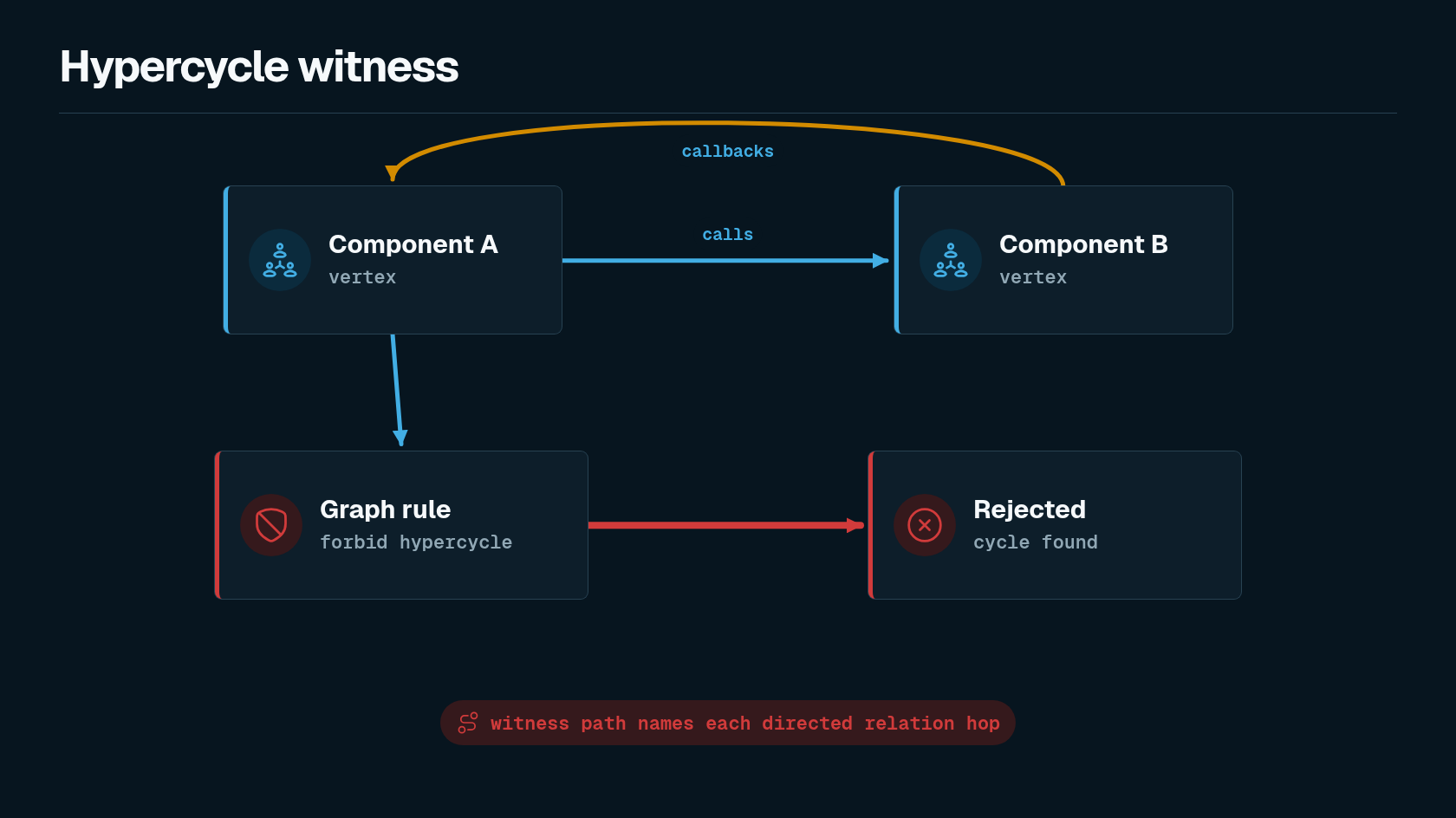
Section titled “Hypercycle rules”Hypercycles are cycles in the directed hypergraph. The checker traverses each relation kind according to its prelude traversal semantics: directed binary kinds contribute one step per relation; ordered kinds contribute consecutive steps along their declared member order.
module gateway
component Gateway {}
component AuditStore {}
relation GatewayCallsAudit {  kind calls  connects Gateway -> AuditStore}
relation AuditCallsGateway {  kind callbacks  connects AuditStore -> Gateway}
rule no_runtime_cycle {  forbid hypercycle over calls or callbacks}
forbid hypercycle without over looks for cycles across every relation kind that participates in directed traversal.
After relation-kind filtering, the checker partitions the traversal graph into strongly connected components and reports the shortest cycle witness. Equal-length witnesses are resolved in canonical name order, so the result does not depend on relation declaration order.
error: forbidden hypercycle
rule no_runtime_cycle rejects this hypercycle:  calls GatewayCallsAudit  callbacks AuditCallsGatewaywitness: AuditStore -> Gateway -> AuditStore
Other rule forms
Section titled “Other rule forms”Rules also support:
when subject has TraitNamewithforbid/forbid finaleffect patterns for rule-derived final forbids- module-qualified references for subjects, endpoints, and traits
Final forbids from rules remain non-overridable by grants, rationale, memory, or reevaluation. Unsupported multi-subject condition shapes are rejected as invalid rules rather than silently ignored.
Inspect the hypergraph
Section titled “Inspect the hypergraph”shp graph show Gatewayshp graph show Gateway --kind callsshp graph statsshp graph show prints hyperedges incident to the symbol. --kind filters by relation kind.
Practice
Section titled “Practice”Do:
- Encode stable structural policy as
forbid provides,forbid path, orforbid hypercyclewith an explicit kind filter when possible. - Prefer prelude kinds with directed traversal for any rule that must search the graph.
- Use graph witnesses in review: break or redirect a cited relation rather than weakening the rule casually.
- Keep path endpoints distinct; use hypercycle rules for cycles.
Do not:
- Expect custom relation kinds without directed traversal to participate in path or hypercycle search.
- Use identical path endpoints to mean “no cycles.”
- Rely on declaration order for witness stability; the checker canonicalizes witnesses.
- Attempt to waive a rule-derived final forbid with design memory.