Diagnostics and Provenance
Diagnostics are a primary product surface for Shape. A useful diagnostic names the failed claim, shows why it failed, and points at the declarations or evidence that caused the rejection. Diagnostics judge the declared .shape model; they do not prove that arbitrary application code is correct.
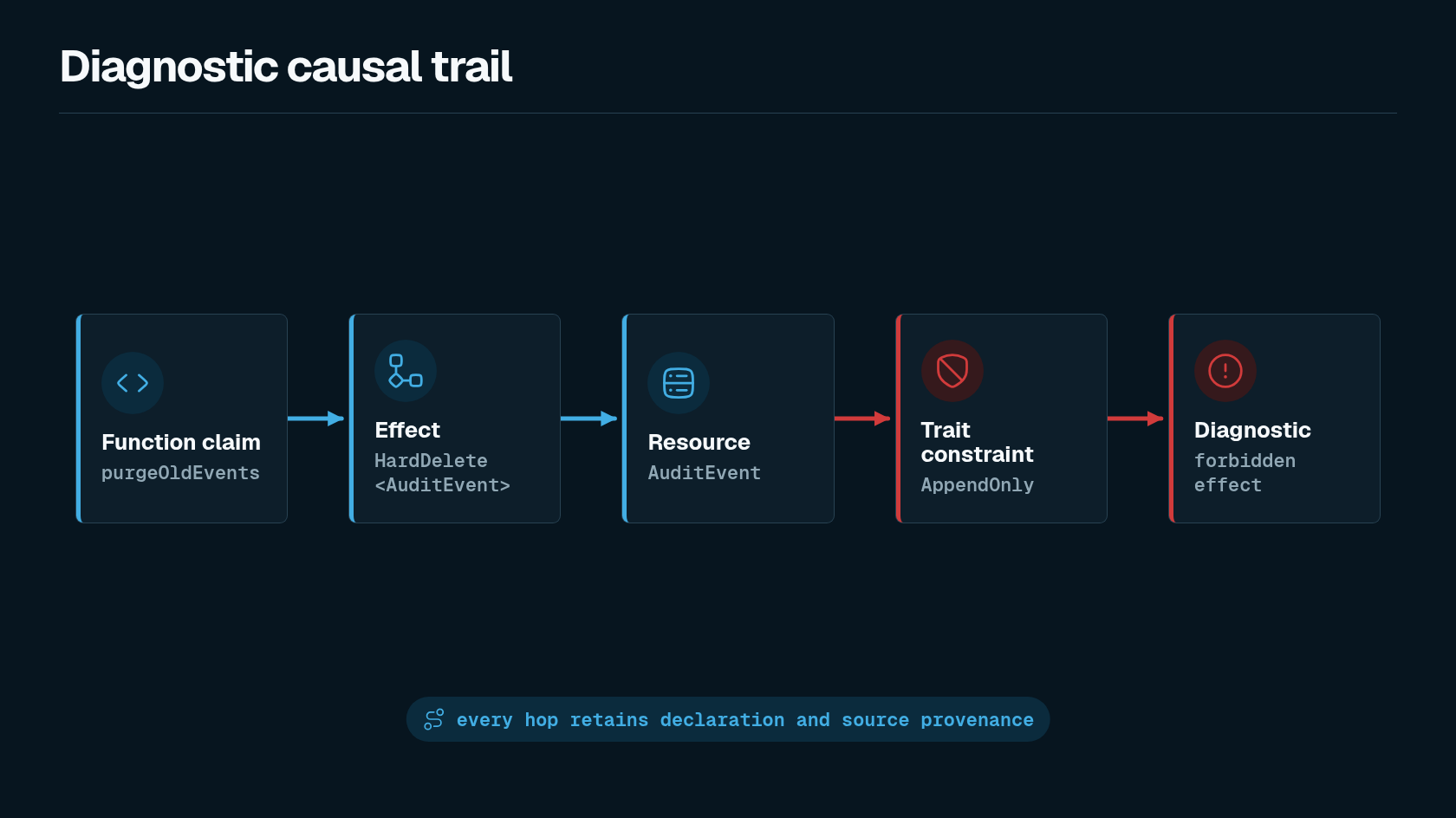
A useful diagnostic follows a causal path such as:
function emits effecteffect targets resourceresource has traittrait derives forbidden effectcomponent grant does not override final forbidDiagnostics are ordered deterministically: by diagnostic kind, then by rendered text. Reordering declarations in .shape files does not churn checker output for the same model.
Example: forbidden effect
Section titled “Example: forbidden effect”The hard-delete fixture fails because the function emits an effect that the resource trait forbids finally:
error: forbidden effect
AuditStore.purgeOldEvents emits HardDelete<AuditEvent>.AuditEvent has trait AppendOnly.AppendOnly forbids final HardDelete<AuditEvent>.evidence: ts("src/audit/purge.ts#purgeOldEvents")
caused by:  - fixtures/fail/append_only_hard_delete/audit.shape: effect AuditStore.purgeOldEvents emits HardDelete<AuditEvent>  - fixtures/fail/append_only_hard_delete/audit.shape: resource AuditEvent : AppendOnly  - fixtures/fail/append_only_hard_delete/audit.shape: trait AppendOnly forbids final HardDelete<T>
Reproduce with:
shp check fixtures/fail/append_only_hard_delete/audit.shapeProvenance
Section titled “Provenance”Shape keeps the declarations that caused a violation close to the diagnostic. Effect evidence makes the final step reviewable when present:
HardDelete<AuditEvent> evidence ts("src/audit/purge.ts#purgeOldEvents")The fragment above is intentionally incomplete (shape no-verify). In a full function summary, the evidence sits on the emitted effect. The diagnostic should lead the reviewer from the failed function to the source span behind the claim.
Graph and path rules use a similar pattern: they cite the rule, the relations that form the witness, and a vertex path. See Rules and Hypercycles.
Common diagnostic families
Section titled “Common diagnostic families”| Kind | Typical cause |
|---|---|
forbidden effect | Emitted effect matches forbid final from a trait or rule. |
missing grant | Function emits an effect the component does not grant. |
unknown effects | Authored function still declares effects unknown. |
governed source changed without current Shape update | Coverage: governed path changed without current update or attestation. |
forbidden path / forbidden hypercycle / forbidden provides | Structural rule matched a witness in the relation hypergraph. |
missing required context / guarded shape changed | Shape trait or guard obligation not satisfied. |
stale design memory | review_by is past under --strict-freshness / --as-of. |
Full message shapes and fixes are catalogued in Diagnostics.
Practice
Section titled “Practice”Do:
- Read the first lines for the claim, then the
caused bylist for the contributing declarations. - Fix final-forbidden effects by changing the architecture or the implementation claim; do not add memory to waive them.
- Keep evidence on production effects so forbidden-effect diagnostics can point at a source span.
- Treat diagnostic text as a review surface: stable wording and order matter for CI diffs.
Do not:
- Silence a final forbid with rationale, reevaluation, or grants.
- Assume an analyzer warning is the same as a checker diagnostic; analyzer output is advisory.
- Expect declaration order to change diagnostic order; order is canonicalized.
- Ignore
caused bywhen several declarations interact.