Resources, Traits, and Effects
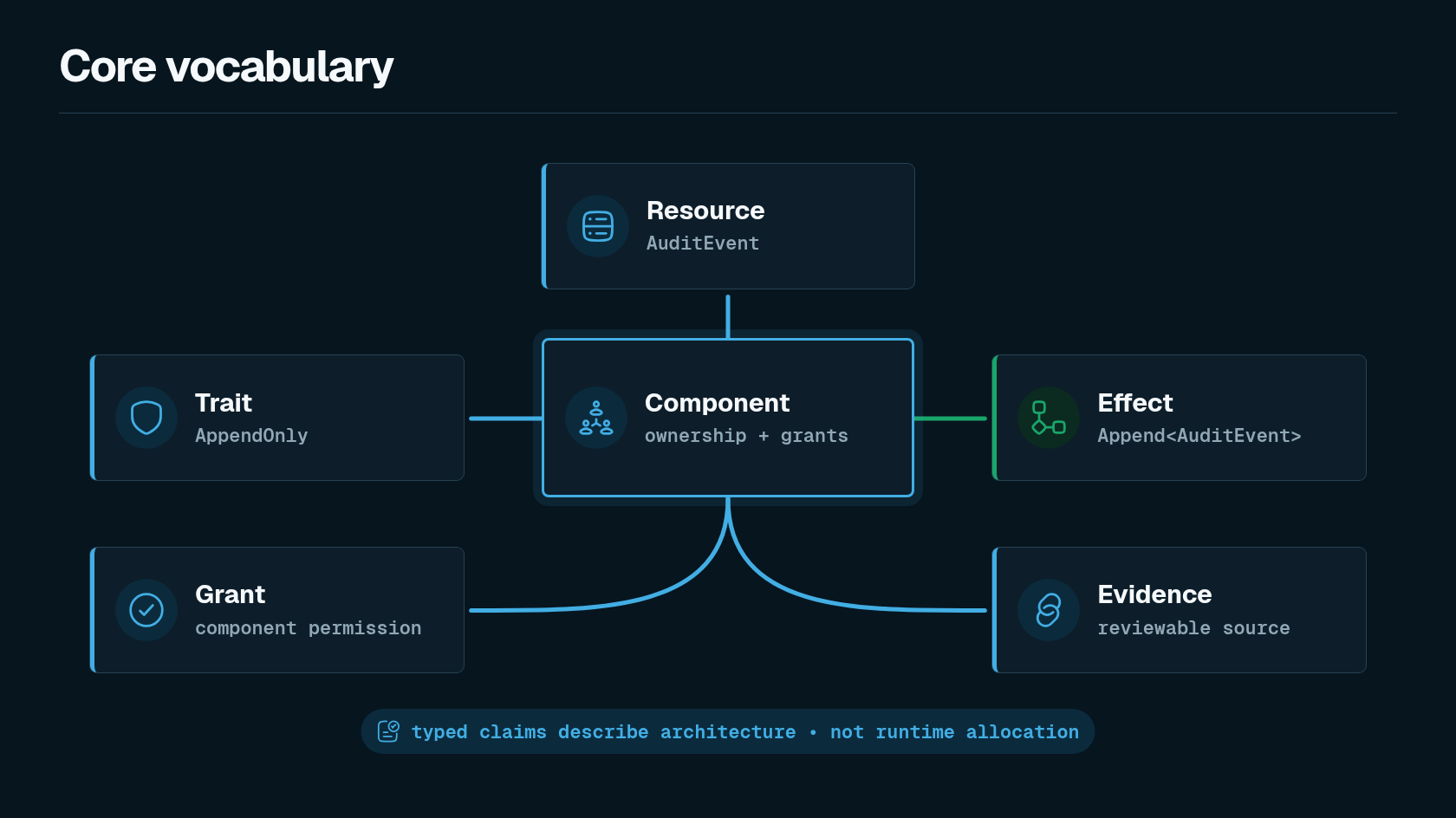
Resources, traits, and effects are the basic vocabulary for architecture claims in Shape. Humans and agents declare what is protected, which operations are allowed or forbidden, and which effects a function claims to emit. The deterministic checker accepts or rejects those claims against the declared model. It does not prove that application code is correct.
Resources
Section titled “Resources”A resource is an architectural target the model cares about: a table, stream, bucket, ledger, queue, secret, endpoint, or domain object. It does not have to be a runtime type.
module audit
resource AuditEvent : AppendOnly
AppendOnly is a prelude trait. Projects may also declare custom resource traits. Resources may carry optional storage metadata and fingerprints; those matter for review and for AST-anchor pinning (see AST Generation).
Traits
Section titled “Traits”Resource traits derive allowed, required, and forbidden effect patterns:
module audit
trait DurableLog<T: Resource> {  allow Append<T>  allow Read<T>  require Append<T>  forbid final HardDelete<T>}
resource AuditEvent : DurableLog| Member | Checker meaning |
|---|---|
allow | Documents an effect that fits the trait. |
require | Records an effect pattern that must appear for the resource. |
forbid final | Rejects matching emitted effects even when a component grants them. |
forbid final is non-overridable. Rationale, design memory, reevaluation, and grants cannot waive it.
Traits can be generic. Trait applications are named on the resource; the checker derives concrete constraints for that resource:
module shared
trait Protected<T: Resource> {  forbid final HardDelete<T>}
resource AuditEvent : Protected
Function shape traits such as PreserveInline, RequiresDescription, and RefactorSensitive do not derive resource-effect policy. They create review obligations (rationale, memory, description, or reevaluation). See Refactor Constraints.
Effects
Section titled “Effects”Effects describe what a function claims to do to a resource. They appear in function summaries under a component:
module audit
resource AuditEvent : AppendOnly
component AuditStore {  owns AuditEvent  grants Append<AuditEvent>  fn appendEvent    source ts("src/audit/store.ts#appendEvent")    effects complete {      Append<AuditEvent>        evidence ts("src/audit/store.ts#appendEvent")    }}
The checker cares about the declared effect, its target resource, component grants, trait forbids, and evidence or source provenance attached to the claim. Structural links between components and resources are not effects; they are top-level relation declarations. See Relations and Hypergraphs.
Use effects complete only when the summary is intended to be exhaustive. Prefer effects unknown when analysis is incomplete rather than an empty complete block that pretends certainty. See Unknowns and Safety.
Practice
Section titled “Practice”Do:
- Model durable architectural targets as resources, even when they are not a single runtime type.
- Put policy that must never be waived in
forbid finalon a resource trait. - Attach
sourceand per-effectevidenceso reviewers can open the supporting code. - Keep effect names from the prelude (
Read,Append,HardDelete, …) or project-defined patterns that the model actually checks.
Do not:
- Treat an empty
effects complete { }as “no effects yet.” That claims completeness. - Expect a grant to override a final forbid.
- Encode structural call or provide edges as effects; use
relation. - Rely on the analyzer to invent missing effects. Analyzer hints are advisory only.