What Shape Is
Shape is a typed architecture conformance language. It records the semantic shape of a system in .shape files that reviewers can read and a deterministic checker can evaluate.
Shape is not a general-purpose programming language. .shape files do not execute application logic, compile application source, or replace tests. They state explicit architecture claims, for example:
- this resource is append-only
- this component owns that resource and may emit these effects
- this function emits these effects, with optional source evidence
- this implementation path is governed by a component shape
- this refactor-sensitive function has recorded design context
- this change set updates the Shape model, or attests that no model change is required
Product boundary
Section titled “Product boundary”authored .shape claims+ human review of those claims+ deterministic checker+ CI enforcement.shape files are the source of architectural truth for Shape. Application code can be messy, implicit, or spread across many files; Shape provides a compact, reviewable model surface.
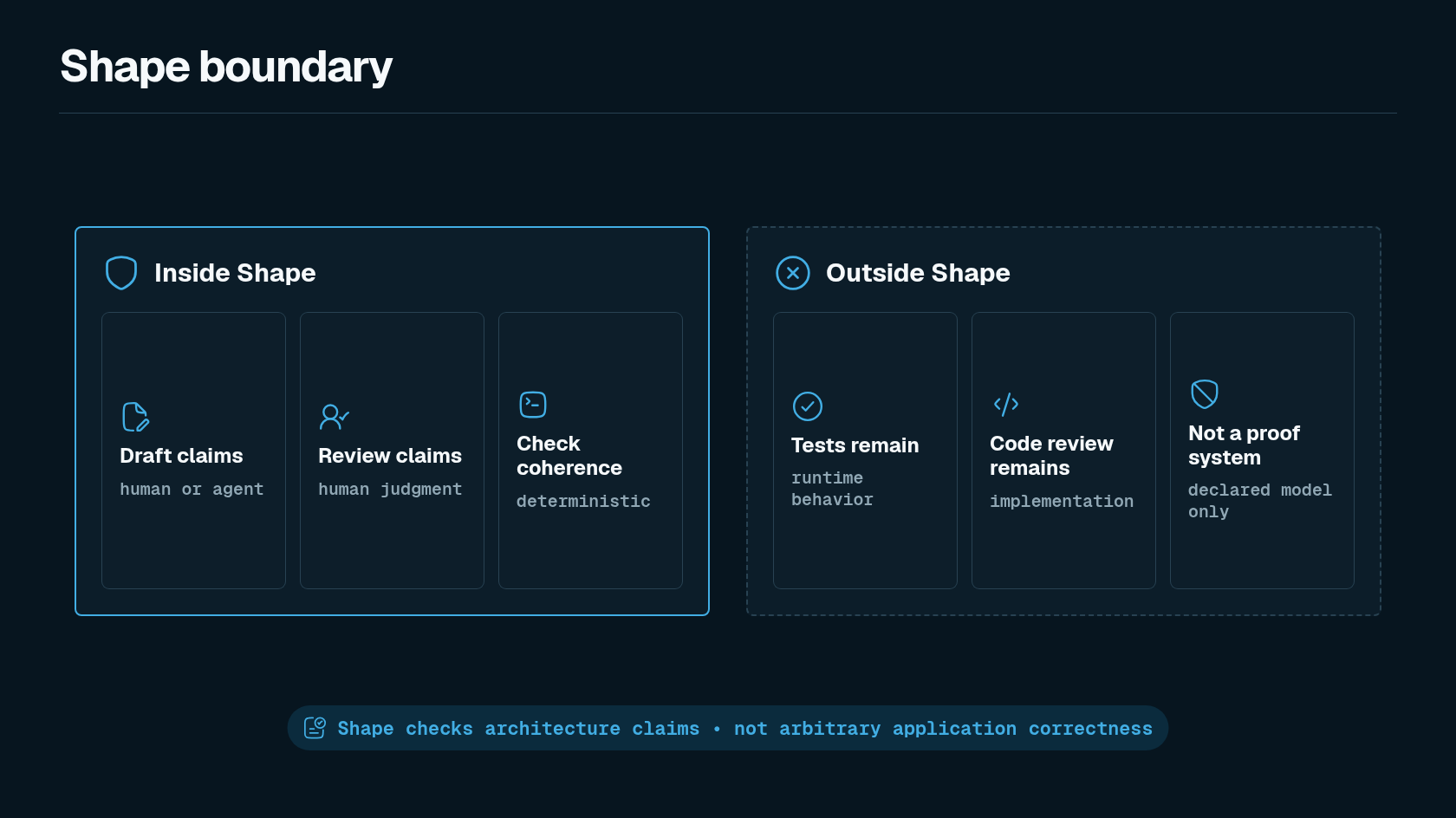
The checker judges the claims in .shape files. It does not prove that implementation code matches the model at runtime. Optional source analyzers can point out suspicious omissions; analyzer hints do not replace the declared model.
Final forbids are final. Rationale, memory, reevaluation, and component grants cannot waive a forbid final. Prefer effects unknown when effects are not yet known over an empty effects complete summary that pretends completeness.
Good for
Section titled “Good for”- Declaring resource invariants (for example append-only storage) that must hold across PRs
- Making ownership, grants, and function effect summaries reviewable in the same place
- Enforcing that governed source changes come with a Shape update or a narrow current attestation
- Binding Shape-affecting changes to docs or other review surfaces
- Capturing design memory and reevaluation obligations for fragile function shapes
- Checking structural relation rules (hypercycles, provides boundaries) over a declared hypergraph
- Emitting deterministic diagnostics with provenance for CI and review
Not good for
Section titled “Not good for”- Proving correctness of arbitrary application behavior
- Replacing tests or code review
- Fully inferring architecture from source without human-reviewed claims
- Softening final forbids through grants, memory, or reevaluation
- Hiding incomplete analysis behind empty complete effect lists
Core workflow
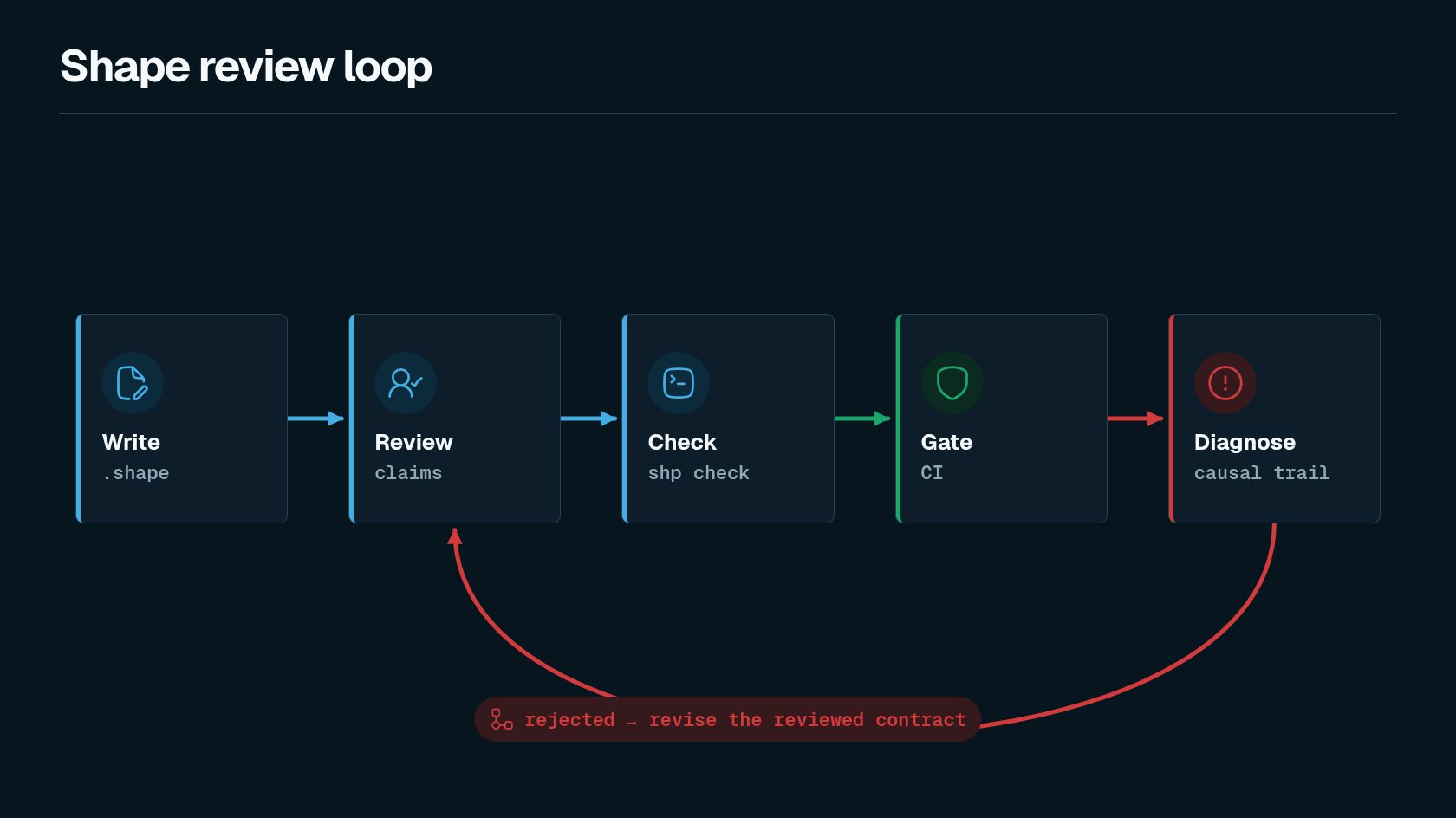
Section titled “Core workflow”- An architecture model lives under
shape/**/*.shape(default discovery forshpcommands with no file arguments). - PRs update that model when source behavior changes the architecture contract.
- Reviewers inspect source and evidence refs attached to material effects.
- Reviewers inspect rationale, memory, or reevaluation attached to refactor-sensitive targets.
- CI runs
shp check, oftenshp coverage --changed-files, format checks, and the repo’s usual tests and type checks. - Diagnostics explain which claim failed and which declaration or evidence caused it.
Mental model
Section titled “Mental model”| Layer | Role |
|---|---|
| Resource + trait | What is protected and which effects are allowed, required, or finally forbidden |
| Component | Ownership, grants, and function effect summaries for a boundary |
| Relation | Structural links between components or resources (not nested inside components) |
| Implementation + coverage | Which source paths are governed and must update Shape when they change |
| Memory / reevaluation | Design context and review obligations for non-obvious or guarded shapes |
| Checker | Deterministic accept/reject of model coherence and review obligations |
Practice
Section titled “Practice”Do
- Keep claims narrow and evidence-backed when effects matter for review
- Use
effects unknownwhile analysis is incomplete; resolve unknowns before treating the model as review-ready - Update the global model under
shape/when architecture behavior changes - Run
shp check(and coverage with changed files when relevant) before merge
Do not
- Assume a grant overrides a
forbid final - Commit empty
effects completeblocks for functions whose effects are still unknown - Treat analyzer output as approval of the model
- Expect Shape to validate runtime behavior that is outside the declared claims
Related pages
Section titled “Related pages”- Quickstart — install and run
shp - First Shape File — minimal resource and component model
- Unknowns and Safety — when to use
effects unknown - Resources, Traits, and Effects — core vocabulary
- CLI Reference — commands and flags