Checker Pipeline
The checker reads .shape files and check options, and nothing else. checkShapeFiles parses every file with the Langium grammar (Langium Grammar), lowers the parsed modules into one Model (Fact Lowering), runs the semantic checks and binding enforcement over that model (Rule Evaluation), and returns a CheckResult with sorted diagnostics. Each phase reads only the previous phase’s output: rules read the Model and check options, and formatDiagnostics reads only the CheckResult.
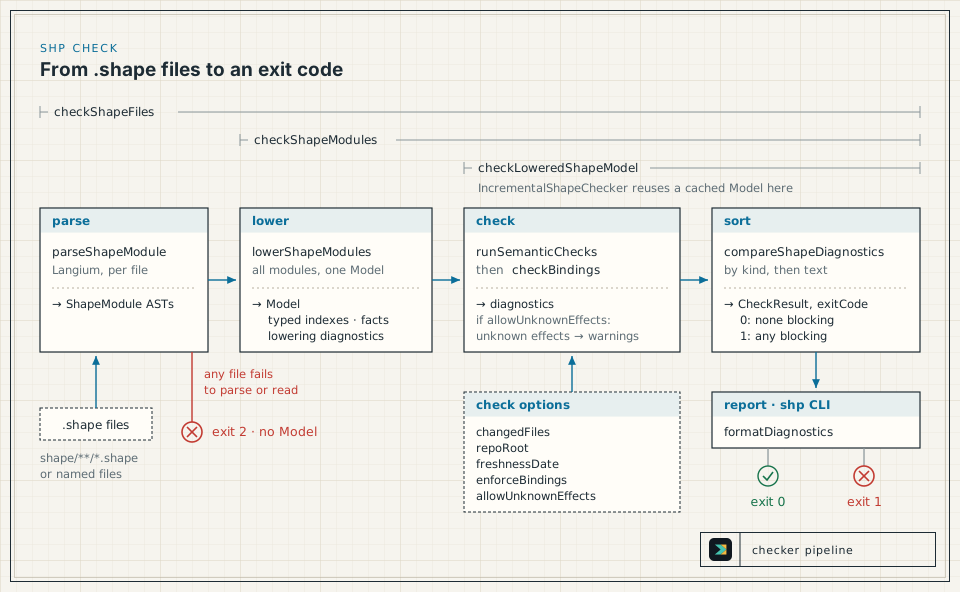
Phases
Section titled “Phases”Paths are relative to packages/shp-checker/src/.
| Phase | Code | Output | Failure outcome |
|---|---|---|---|
| Read and parse | checkShapeFiles reads each path; parseShapeModule in parser.ts parses it with the Langium services from language/shape-module.ts. | One ShapeModule AST per file. | A read error, or any lexer or parser error in any file, ends the check. The result holds only parse diagnostics, exitCode is 2, and no Model is built. |
| Lower | lowerShapeModules in checker/lowerer.ts, driving the domain lowerers in checker/lowering/*. | Model: typed indexes, facts, and lowering diagnostics. | Lowering always completes. Problems it finds (duplicate declarations, ambiguous or unknown names, invalid relations, invalid candidate effects, invalid require_context) become model.diagnostics. |
| Check | runSemanticChecks runs SEMANTIC_CHECKS in checker/rules.ts; then checkBindings runs unless enforceBindings is false. | Semantic diagnostics. | No check stops a later one; each appends its diagnostics. |
| Assemble | checkLoweredShapeModel in checker/api.ts. | CheckResult: ok, exitCode, sorted diagnostics, and facts when includeFacts is set. | exitCode is 1 when any blocking diagnostic remains; stale attestations and downgraded unknown_effects are warnings. |
| Render | formatDiagnostics in checker/diagnostics.ts. | Text. | None. It reads only the CheckResult. |
checkLoweredShapeModel assembles the diagnostic list in a fixed order: lowering diagnostics, then the registry’s output, then binding diagnostics. It then applies the allowUnknownEffects downgrade, computes ok and exitCode, sorts the diagnostics, and attaches sorted facts when requested. The sort makes the assembly order invisible in the returned list.
Entry points
Section titled “Entry points”checkShapeFiles(paths, options)is the pathshp checktakes. It reads and parses every path, in the given order, before lowering any of them. When all of them parse, it classifies each module’s origin withmoduleOriginForShapeFileagainst the normalizedrepoRootand passes the modules tocheckShapeModules. A module is generated AST only when its name isshape.generated.astor starts withshape.generated.ast., and its path relative torepoRootis undershape/generated/ast/.checkShapeModules(modules, options)takes parsedShapeModule[]orCheckModuleInput[](module, optionalfilePath, optionalorigin). It trusts only explicit origins: an input withoutorigin: "generated_ast"is authored. It normalizes the options, callslowerShapeModules, and passes the model tocheckLoweredShapeModel. It never returns exit code2.checkLoweredShapeModel(model, normalizedOptions)is internal.checker/api.tsexports it, but the package does not. Both entry points and the incremental checker assemble their results through it. WhencheckLooseningadds diagnostics afterwards,checkShapeModulesrecomputesokand the order with the same helpers,isWarningandcompareShapeDiagnostics.IncrementalShapeCheckercaches parsed documents and the last lowered model for callers that check an in-memory workspace repeatedly. See Incremental checking.
@shape/shp-checker (src/index.ts) exports checkShapeFiles, checkShapeModules, and IncrementalShapeChecker. It does not export lowerShapeModules or checkLoweredShapeModel. The read-only query helpers in checker/query.ts (explainShapeModules, graphShapeModules, listMemoryGuardsShapeModules, and others) lower the modules themselves and never decide pass or fail; listShapeObligations calls checkShapeModules and filters its diagnostics.
normalizeCheckOptions resolves the repository root, summarizes any base model, and validates the freshness date before semantic checking:
| Option | Default | Read by | Effect |
|---|---|---|---|
changedFiles | none | checkCoverage, checkBindings | Paths are normalized against repoRoot. With no paths, coverage and bindings report nothing. |
baseModules | none | checkCoverage, checkBindings, checkGuardedSources, checkStaleAttestations | Summarized once into attestation, reevaluation, and context keys. An attestation identical to the base does not count and is reported as stale_attestation. |
checkLoosening | off | checkShapeModules | Reverts each rule-layer edit to the base in turn and reports rule_loosening. Requires baseModules. |
repositoryFiles | none | checkCitedPaths, the loosening check | Every file in the repository. Cited paths must be in it, and the loosening check ignores coverage errors about files the change deleted. |
repoRoot | the working directory | checkShapeFiles, checkCoverage, checkBindings | Resolved to an absolute path. It classifies module origins and normalizes absolute changed-file and provenance paths. |
freshnessDate | unset | checkFreshness | An ISO YYYY-MM-DD date; unset turns freshness off. An invalid value throws a TypeError instead of producing a diagnostic. |
enforceBindings | on | checkLoweredShapeModel | false skips checkBindings. |
allowUnknownEffects | off | checkLoweredShapeModel | Downgrades every unknown_effects diagnostic to severity warning before ok is computed. |
includeFacts | off | checkLoweredShapeModel | Returns model.facts in the result. |
lowerShapeModules takes no options. Only repoRoot can affect its input, through origin classification in checkShapeFiles and the incremental checker, so one lowered Model can be checked under any values of the other options.
Pass condition and exit codes
Section titled “Pass condition and exit codes”CheckResult.ok is true when every diagnostic is non-blocking, including when there are none. Only two kinds are non-blocking: stale_attestation, always, and unknown_effects once allowUnknownEffects has set its severity to warning.
exitCode | Meaning |
|---|---|
0 | ok is true. formatDiagnostics prints Shape check passed., or the warnings followed by Shape check passed with warnings. |
1 | The model was lowered, and at least one blocking diagnostic remains. |
2 | checkShapeFiles could not read or parse at least one file. Only parse diagnostics are reported, and no semantic check ran. |
The exit codes of each shp command, including usage errors, are listed in the CLI Reference.
Determinism
Section titled “Determinism”The same .shape files and check options produce the same lowered model, facts, and diagnostics. The order of diagnostics is deterministic over the input set, not its source order:
checkLoweredShapeModelsorts diagnostics withcompareShapeDiagnosticsfromchecker/diagnostics.ts: by kind, then by rendered text, comparing by Unicode codepoint (compareCodepointStrings), so the order does not depend on locale. Diagnostic order therefore depends on neither theSEMANTIC_CHECKSorder nor declaration order.- With
includeFacts, facts are sorted by the codepoint order of their JSON text. - A parse-failure result is not sorted. Parse diagnostics follow the order of the input paths, and within one file lexer errors come before parser errors.
shpsorts the paths its default discovery finds; explicit file arguments keep their order. - The checker never reads the system clock.
checkFreshnesscompares against the injectedfreshnessDate; the CLI computes today’s date when--strict-freshnessasks for it. forbid pathandforbid hypercyclewitnesses are chosen canonically. The algorithm and its tie-breaks are in Rule Evaluation.
packages/shp-checker/src/behavioural/determinism.test.ts enforces these properties: byte-identical output across repeated runs of every public surface, identical diagnostics under a permutation of top-level declarations, and no clock reads in the checker.
Incremental checking
Section titled “Incremental checking”IncrementalShapeChecker serves library callers that check an in-memory workspace repeatedly. Each check(documents, options) call supplies the complete current snapshot, so a document missing from the list counts as removed. It returns the CheckResult and an invalidation report.
import { IncrementalShapeChecker } from "@shape/shp-checker";
const checker = new IncrementalShapeChecker();const { result, invalidation } = checker.check(  [{ filePath: "shape/history.shape", source: "module history\nresource Revision\n" }],  { includeFacts: true });
Any document change rebuilds the complete Model and fact list, because imports, duplicate declarations, change blocks, concrete targets, and derived facts cross file boundaries. No file owns an independent fact shard.
| Change since the previous call | Reparsed | Model and facts | Rules | Report (causes; derivedFacts; diagnostics) |
|---|---|---|---|---|
| First call | every document | built | run | initial_check; rebuilt; recomputed |
A document added, removed, or changed (its source or explicit origin) | changed documents only | rebuilt | rerun | shape_documents_changed; rebuilt; recomputed |
Options only, and the new repoRoot reclassifies a document with an absolute path and no explicit origin | none | rebuilt without reparsing | rerun | check_options_changed; rebuilt; recomputed |
Any other options-only change, including changedFiles | none | reused | rerun | check_options_changed; reused; recomputed |
| Nothing | none | reused | not run; the previous result is returned | empty; reused; reused |
| Any document fails to parse | changed documents | discarded | not run; the result holds only parse diagnostics, exit code 2 | the cause from the matching row above; unavailable; recomputed if documents changed, otherwise reused |
causes lists both shape_documents_changed and check_options_changed when a call changes documents and options together.
The boundary contracts:
- Document paths must be unique within a snapshot. A duplicate path throws a
TypeErrorrather than letting array order decide which source wins. reparsedDocuments,reusedDocuments, andremovedDocumentsare sorted by codepoint.- Every returned
CheckResultis astructuredCloneof the cached one, so a caller’s mutation cannot corrupt the cache. - Like
checkShapeFiles, the incremental checker classifies implicit origins against the normalizedrepoRoot, which defaults to the working directory.
The cache changes how much work is reused, not what the checker decides. Rules always run through checkLoweredShapeModel, and packages/shp-checker/src/checker/incremental.test.ts compares incremental results with the uncached full check, which remains authoritative.
Where changes belong
Section titled “Where changes belong”| Change | Where |
|---|---|
| Syntax | language/shape.langium, then regenerate. See Langium Grammar. |
| Parse diagnostics | parser.ts |
| Model, fact, diagnostic, and option types | checker/model.ts, which holds data shapes only |
| Pass order during lowering | checker/lowerer.ts |
| Lowering one kind of declaration | checker/lowering/* |
| Name and module resolution | checker/symbols.ts and module-resolution.ts |
change staging and change events | checker/lowering/changes.ts and checker/change-planning.ts |
| Prelude traits, context obligations, and relation kinds | prelude.ts; checker/prelude-seed.ts seeds its traits and obligations into the model |
| Queries shared by lowering, rules, and helpers | checker/derivations.ts |
| A semantic check | a module under checker/rules/, registered in SEMANTIC_CHECKS. See Rule Evaluation. |
| Guard matching over change events | memory-guards.ts |
| Pass condition, option normalization, and result assembly | checker/api.ts |
| Diagnostic text and ordering | checker/diagnostics.ts |
explain, graph, memory, and obligations output | checker/query.ts |
shp inspect output | checker/inspection.ts |
| Incremental reuse | checker/incremental.ts |
Analyzer hints, AST drafts, and the authoring helpers sit outside this pipeline and never decide pass or fail; see Helper APIs. The experiments in src/experiments/ and experiments/semantic-kernel/ also stay outside it; see Rule Evaluation.