Components, Ownership, and Grants
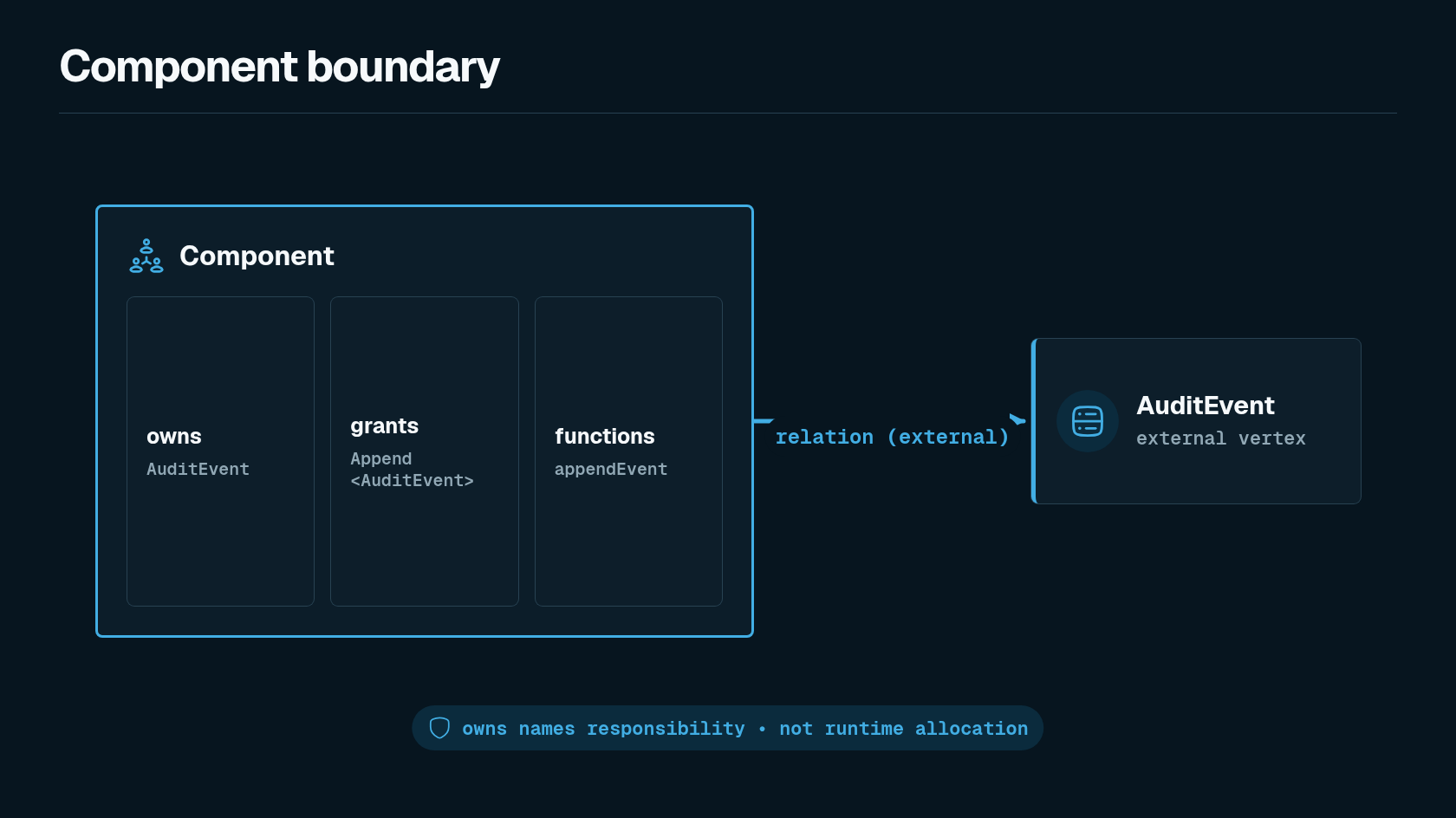
Components are the main boundary for authority and behavior claims: what a component owns, which effects its functions may emit, and which function summaries it provides. The checker evaluates those claims in the declared .shape model. It does not allocate runtime ownership or execute application code.
Components do not carry structural dependencies. Calls, provides, callbacks, and multi-party coordination live in top-level relation declarations. See Relations and Hypergraphs.
module audit
resource AuditEvent : AppendOnly
component AuditStore {  owns AuditEvent  grants Append<AuditEvent>  grants Read<AuditEvent>  fn appendEvent    source ts("src/audit/store.ts#appendEvent")    effects complete {      Append<AuditEvent>        evidence ts("src/audit/store.ts#appendEvent")    }}
Ownership
Section titled “Ownership”owns AuditEvent states that this component owns the resource in the architecture model. Ownership is a review claim used for structure and explanation, not a runtime allocation.
Grants
Section titled “Grants”grants Append<AuditEvent> states that functions in this component may emit that effect. If a function emits an effect without a matching grant, the checker reports missing grant.
Grants do not override final forbids. This model still fails with forbidden effect:
module audit
trait AppendOnly<T: Resource> {  forbid final HardDelete<T>}
resource AuditEvent : AppendOnly
component AuditStore {  owns AuditEvent  grants HardDelete<AuditEvent>  fn purgeOldEvents    source ts("src/audit/purge.ts#purgeOldEvents")    effects complete {      HardDelete<AuditEvent>        evidence ts("src/audit/purge.ts#purgeOldEvents")    }}
AuditEvent : AppendOnly derives a final forbid for HardDelete<AuditEvent>. The grant is not enough; design memory and reevaluation cannot waive the forbid either.
Function summaries
Section titled “Function summaries”Each fn member declares the function’s optional shape traits, source, optional description, and either effects complete or effects unknown. Function-level requires is a capability term used with unsafe effects; it is unrelated to structural dependencies between components.
Shape traits on functions (for example RefactorSensitive or PreserveInline) create review obligations. See Refactor Constraints.
Structural dependencies
Section titled “Structural dependencies”Structural links between components and resources live only in top-level relation declarations, never inside a component block:
module audit
resource AuditEvent
component Gateway {}
component AuditStore {}
relation GatewayCallsAudit {  kind calls  connects Gateway -> AuditStore}
Practice
Section titled “Practice”Do:
- Put ownership, grants, and function effect summaries on the component that actually holds that authority in the architecture.
- Grant only effects the component is allowed to emit under resource traits.
- Keep call, callback, provide, and coordination edges in
relationdeclarations. - Map source paths to components with
implementationblocks when coverage should govern them. See Implementations and Coverage.
Do not:
- Nest structural dependencies inside the component body.
- Use a grant to paper over a final forbid.
- Mark production boundaries as complete with
effects unknownleft unresolved in CI. - Treat
ownsas a memory-management or deployment claim.