Unknowns and Safety
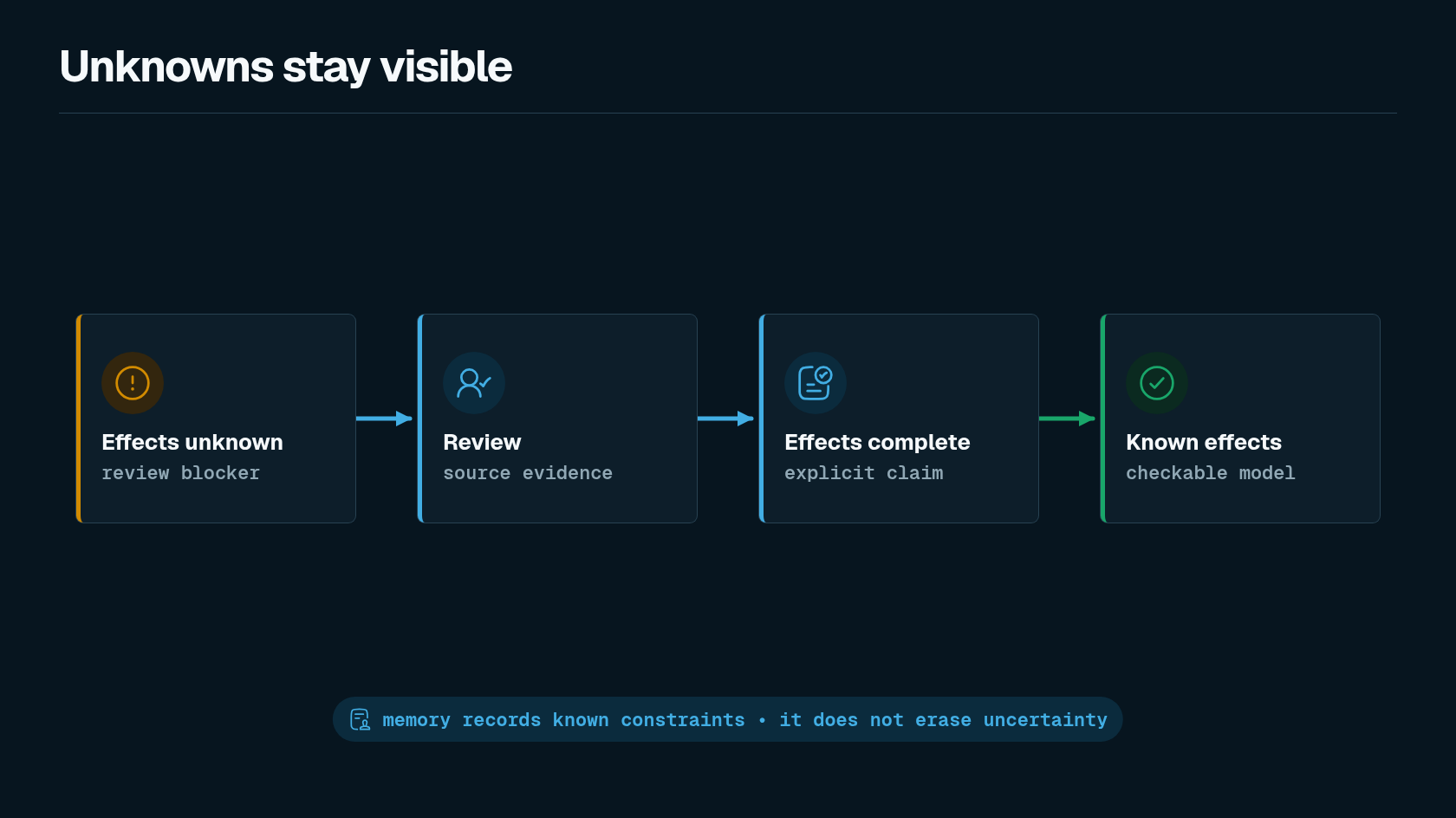
Shape should not hide uncertainty. If a function’s effects are not known yet, declare effects unknown instead of inventing an empty complete summary. The checker treats authored unknowns as errors by default so incomplete analysis stays visible in CI. Shape still does not prove that application code is correct; it only accepts or rejects the declared model.
module audit
resource AuditEvent : AppendOnly
component AuditStore {  owns AuditEvent  fn importLegacyEvents    source ts("src/audit/import.ts#importLegacyEvents")    effects unknown}
Strict check output:
error: unknown effects
AuditStore.importLegacyEvents declares effects unknown.
effects unknown is valid syntax and a deliberate intermediate state. It is not a safe final state for protected production architecture.
Complete effects
Section titled “Complete effects”Use effects complete only when the summary is intended to be exhaustive:
module audit
resource AuditEvent : AppendOnly
component AuditStore {  owns AuditEvent  grants Read<AuditEvent>  fn listEvents    source ts("src/audit/store.ts#listEvents")    effects complete {      Read<AuditEvent>        evidence ts("src/audit/store.ts#listEvents")    }}
Complete summaries make deterministic grant and forbid checks possible. An empty complete block claims “no effects,” which is different from “not analyzed yet.”
Draft validation flag
Section titled “Draft validation flag”While iterating on a draft, soften only unknown-effect diagnostics:
shp check --allow-unknown-effects draft.shapeUnknown effects become non-fatal warnings. Parse errors, final forbids, missing grants, coverage failures, bindings, and other semantic diagnostics remain blocking.
Generated AST exception
Section titled “Generated AST exception”Generated candidate modules under shape/generated/ast with shape.generated.ast... module names may keep effects unknown together with effect candidate hints. Those unknowns are candidate context, not reviewed completeness. Authored modules still fail on effects unknown under strict check. See AST Generation.
Unexplained refactor constraints
Section titled “Unexplained refactor constraints”effects unknown is for incomplete effect analysis. It is different from a known refactor constraint that the team cannot fully explain yet.
For refactor-sensitive targets, use typed memory with status Unexplained:
module bridge
resource Attestation
component BridgePoller {  owns Attestation  grants Read<Attestation>  fn pollAttestation : RefactorSensitive    effects complete {      Read<Attestation>    }}
memory BridgePollingDelayConstraint : RefactorConstraint<fn BridgePoller.pollAttestation> {  applies_to fn BridgePoller.pollAttestation  status Unexplained  confidence High  summary "Previous attempts to lower this delay caused intermittent settlement failures."  who {    owner BridgeTeam  }}
That keeps the constraint reviewable without pretending the effects are unknown. Design memory cannot waive forbid final. See Refactor Constraints.
Practice
Section titled “Practice”Do:
- Prefer
effects unknownover a false emptyeffects completewhile analysis is incomplete. - Resolve unknowns to source-backed complete summaries before accepting protected changes.
- Use
memorywithstatus Unexplainedfor known-but-not-fully-explained refactor constraints. - Use
--allow-unknown-effectsonly for local draft iteration, not as a permanent CI setting for authored production models.
Do not:
- Omit an effect and leave a complete summary that looks finished.
- Treat analyzer hints as a substitute for declaring unknowns or complete effects.
- Use unknowns or design memory to hide a final-forbidden effect.
- Leave
effects unknownon protected components as the steady state in CI.