First Shape File
This page builds a minimal Shape model: one resource, one component, and function effect summaries. The goal is a module the checker can accept, not a full system model.
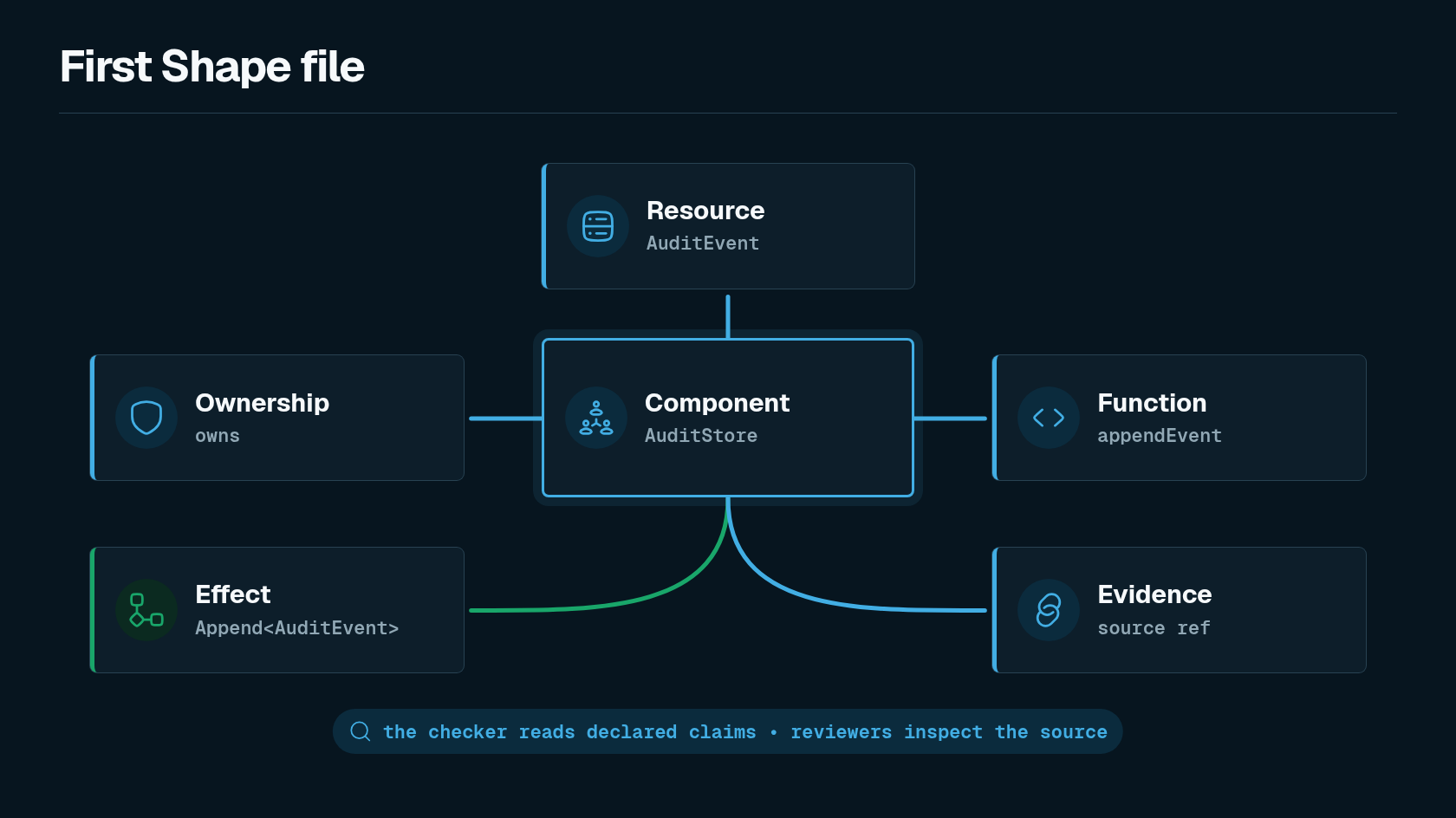
Minimal model
Section titled “Minimal model”AppendOnly is a built-in prelude trait. It finally forbids HardDelete, Truncate, and DropStorage on the resource that carries it. You can redeclare an equivalent trait in project files; fixtures that need a local definition do so explicitly.
module audit
resource AuditEvent : AppendOnly
component AuditStore {  owns AuditEvent  grants Append<AuditEvent>  fn appendEvent    effects complete {      Append<AuditEvent>    }}
Save the module under your project’s default discovery tree, for example shape/audit.shape. With no file arguments, shp check scans shape/**/*.shape. You can also pass the file path explicitly:
shp check shape/audit.shapeExpected result:
Shape check passed.In the Shape language repository, the same pattern is covered by the pass fixture fixtures/pass/append_only_append/audit.shape. Application repos should check their own shape/ files, not that fixture path.
Resource
Section titled “Resource”resource AuditEvent : AppendOnly says AuditEvent is an architectural target governed by the AppendOnly trait.
The checker does not require the resource to exist as a runtime type. It uses the resource as the target of effects, ownership, and trait-derived constraints. See Resources, Traits, and Effects.
Component
Section titled “Component”component AuditStore groups ownership, grants, and function summaries.
owns AuditEventis a review claim about ownership in the architecture model, not a runtime allocator.grants Append<AuditEvent>says functions in this component may emit that effect. Emitting an effect without a matching grant fails the check.- Grants do not override
forbid finalconstraints from traits or rules.
Structural links between components and resources are not declared inside a component. They live in top-level relation declarations. See Relations and Hypergraphs and Components, Ownership, and Grants.
Function summary
Section titled “Function summary”fn appendEvent is not an implementation. It is a summary of the source function’s architectural effects for the model.
effects complete { ... }claims the listed effects are exhaustive for that function.- Use
effects unknownwhen the effects are not yet known. Strictshp checkrejects unknowns so unresolved analysis cannot ship as a complete contract; draft withshp check --allow-unknown-effectswhile authoring. - Prefer an honest
effects unknownover an empty complete summary that pretends completeness.
See Unknowns and Safety.
Evidence
Section titled “Evidence”Source and evidence refs make claims reviewable by humans. The checker does not execute the referenced TypeScript; the refs tell reviewers where to inspect the claim.
module audit
resource AuditEvent : AppendOnly
component AuditStore { owns AuditEvent grants Append<AuditEvent> fn appendEvent source ts("src/audit/store.ts#appendEvent") effects complete { Append<AuditEvent> evidence ts("src/audit/store.ts#appendEvent") }}What fails next
Section titled “What fails next”If you add a function that emits HardDelete<AuditEvent>, the model fails even with a matching grant, because prelude AppendOnly derives a final forbid. Walk through that failure in Append-Only Walkthrough.
Best practices
Section titled “Best practices”Do
- Start with one resource, one owner component, and the functions that touch that resource
- Grant only the effects the component actually needs
- Attach
source/evidencewhen a claim will be reviewed or when coverage needs a current Shape reference - Keep structural dependencies as top-level
relationdeclarations
Do not
- Nest
calls/provideslinks inside the component body - Use empty
effects completeblocks to silence uncertainty - Assume grants can authorize final-forbidden effects
- Treat a passing check as proof that the implementation is correct—only that the declared model is coherent