Rules and Hypercycles
Rules capture project-specific architectural constraints that operate over the structural hypergraph.
module gateway
resource JsonRpcEndpoint
component Gateway {}
relation GatewayProvidesRpc {  kind provides  connects Gateway -> JsonRpcEndpoint}
rule GatewayBoundary {  forbid provides JsonRpcEndpoint except Gateway}
Rules are intentionally narrow. They should encode architecture decisions that are stable enough for CI.
forbid provides
Section titled “forbid provides”forbid provides T except C scans the hypergraph for relations whose kind is provides and whose target endpoint is T. If any relation provides T from a component other than C, the rule rejects the model with a witness that cites the offending relation and component.
Hypercycle rules
Section titled “Hypercycle rules”Hypercycles are cycles in the directed hypergraph. The checker traverses each relation kind according to its traversal semantics from the prelude kind registry: directed binary kinds contribute one step per relation, ordered kinds contribute consecutive steps along their declared member order.
module gateway
component Gateway {}component AuditStore {}
relation GatewayCallsAudit {  kind calls  connects Gateway -> AuditStore}
relation AuditCallsGateway {  kind callbacks  connects AuditStore -> Gateway}
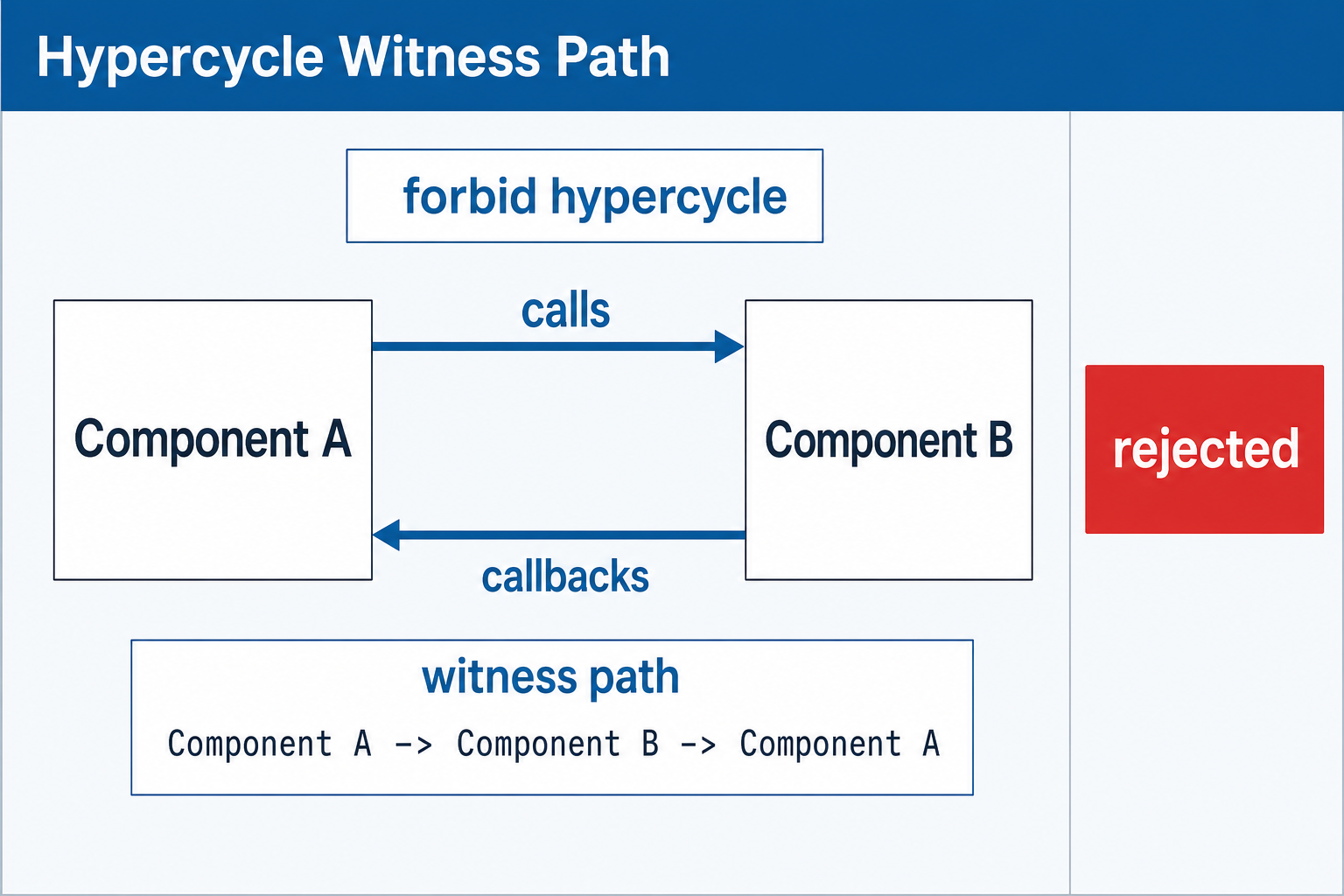
rule no_runtime_cycle {  forbid hypercycle over calls or callbacks}
forbid hypercycle without over looks for cycles across every relation kind that participates in cycle detection.
The diagnostic cites the relations forming the cycle and prints a vertex witness path:
error: forbidden hypercycle
rule no_runtime_cycle rejects this hypercycle:  calls GatewayCallsAudit  callbacks AuditCallsGatewaywitness: AuditStore -> Gateway -> AuditStore
Inspect the hypergraph
Section titled “Inspect the hypergraph”shp graph Gatewayshp graph Gateway --kind callsshp graph prints the hyperedges incident to the symbol, grouped by relation. --kind filters by relation kind so reviewers can focus on a single concern.