Design Memory
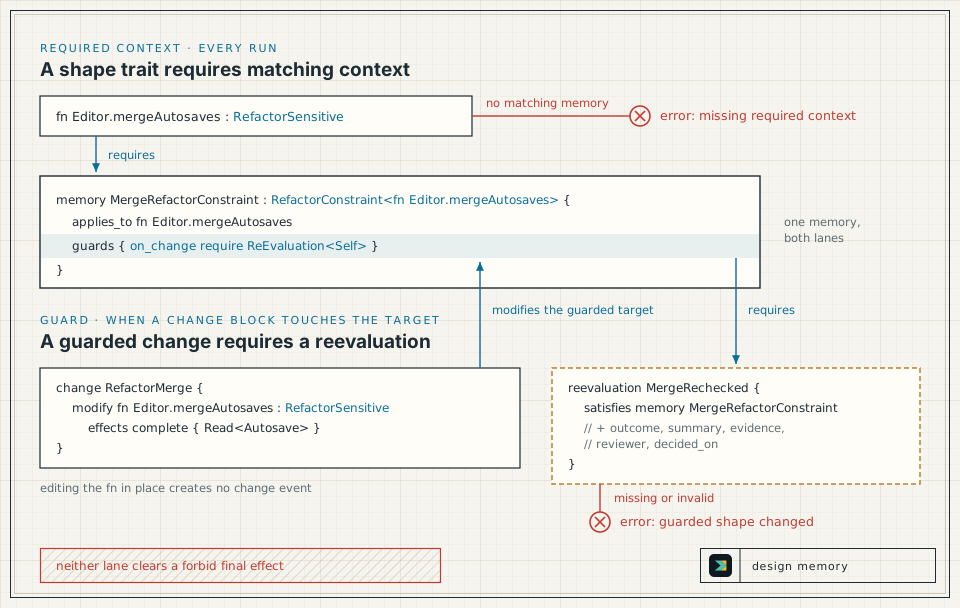
Design memory records why a fragile part of the Shape model looks the way it does, as typed rationale and memory declarations. It covers constraints that an effect summary cannot express: a merge step that must stay inline, an error ordering that callers depend on, compatibility code, or a test-only helper that looks like production code. The checker enforces design memory through two separate mechanisms:
- Required context. A shape trait such as
RefactorSensitiverequires arationaleormemoryof a matching type for the same target.shp checkevaluates this on every run and reportsmissing required contextuntil one exists. - Guards. A
rationaleormemorycan guard its target. When achangedeclaration modifies or removes that target,shp checkreportsguarded shape changeduntil a validreevaluationsatisfies the guarding declaration.
One declaration can take part in both: the same memory can satisfy a trait’s requirement and carry a guard. Neither mechanism can make an effect rejected by a final forbid pass; see Effect Model.
Review freshness is a separate, opt-in check: given a reference date, shp check fails on a context whose review_by date has passed (see Review freshness).
Required context
Section titled “Required context”A minimal example
Section titled “A minimal example”Editor.mergeAutosaves merges a draft’s pending autosaves. The upstream sync library sends autosaves out of order, so the merge must keep its sort; a clean-up that drops the sort looks harmless but breaks the merge. The shape trait RefactorSensitive marks the function as needing recorded context:
module editor
resource Autosave
component Editor {  owns Autosave  grants Read<Autosave>  fn mergeAutosaves : RefactorSensitive    effects complete {      Read<Autosave>    }}
shp check shape/editor.shape exits 1:
error: missing required context
fn Editor.mergeAutosaves has shape RefactorSensitive.RefactorSensitive requires RefactorConstraint<fn Editor.mergeAutosaves>.
No matching rationale or memory found.
caused by:  - shape/editor.shape: fn Editor.mergeAutosaves : RefactorSensitive  - standard prelude: RefactorSensitive requires RefactorConstraint
The prelude defines this requirement: on a function, RefactorSensitive needs a RefactorConstraint for that function, and only a memory satisfies it. Adding one to the module makes the check pass:
memory MergeRefactorConstraint : RefactorConstraint<fn Editor.mergeAutosaves> { applies_to fn Editor.mergeAutosaves status Explained confidence High summary "The sync library sends autosaves out of order, so keep the sort." who { owner EditorTeam }}Shape check passed.Anatomy of a context declaration
Section titled “Anatomy of a context declaration”rationale and memory declarations, together called contexts, share one form: the kind, a name, and a context type written with its target, such as RefactorConstraint<fn Editor.mergeAutosaves>. The target must be a declared fn, component, resource, relation, implementation, or rule; otherwise shp check reports invalid context target.
A context satisfies a trait’s requirement only when its context type name, its kind, and its target all match what the trait requires. A rationale of type RefactorConstraint therefore does not satisfy RefactorSensitive, which accepts only a memory.
applies_to names the target again and must name the same one as the context type. When it names a different target, shp check reports context target mismatch, and the obligation stays unmet, so missing required context is reported as well. When applies_to is omitted, the checker uses the context type’s target.
The remaining members are recorded for reviewers. The checker stores status, confidence, why, and owner as identifiers and summary as text, and shp memory and shp explain display several of them, but the checker never interprets their values. The who { owner ... } and when { review_by ... } blocks each hold one value. Language Syntax lists every member each declaration accepts, and Diagnostics gives the printed form, cause, and fix of every design-memory diagnostic this page names.
Rationale and memory
Section titled “Rationale and memory”A rationale records a deliberate design choice and its reason, given as why. A memory records a known constraint, often one learned from past failures, with status and confidence; only a memory can be marked sensitive (see Approvers and roles). The table in the next section fixes the accepted kind for most traits; among the built-in traits, the choice between the two is open only for ProtectedCheckOrder and NonIdiomatic, which accept either.
status tells reviewers how well a constraint is understood. MergeRefactorConstraint is Explained: its cause is known, because the upstream sync library sends autosaves out of order. status Unexplained records a constraint that is real but whose cause is not yet understood, such as RevisionLogBoundary in Components and resources; it signals to reviewers that the memory still needs an explanation. Neither value is related to effects unknown, which marks incomplete effect analysis: a function whose memory is Unexplained can still have a complete effect summary.
Adding PreserveInline to mergeAutosaves asks for a rationale that explains why the function stays inline:
component Editor {  owns Autosave  grants Read<Autosave>  fn mergeAutosaves : PreserveInline, RefactorSensitive    effects complete {      Read<Autosave>    }}
rationale MergeInline : InlineRationale<fn Editor.mergeAutosaves> {  applies_to fn Editor.mergeAutosaves  why CognitiveLocality  summary "Merge steps stay inline so reviewers can read the conflict rules in one place."  who {    owner EditorTeam  }}
With this rationale and MergeRefactorConstraint both present, the check passes.
Built-in shape traits
Section titled “Built-in shape traits”The prelude defines six shape traits. Each one requires a context type for the same target, satisfied by the kinds listed:
| Shape trait | Targets | Required context type | Satisfied by |
|---|---|---|---|
PreserveInline | fn | InlineRationale | rationale |
RequiresDescription | fn | DescriptionRationale, plus a non-empty description | rationale |
ProtectedCheckOrder | fn | CheckOrderRationale | rationale or memory |
RefactorSensitive | fn, component, resource | RefactorConstraint | memory |
NonIdiomatic | fn, component, resource | DesignRationale | rationale or memory |
TestOnly | fn, component | TestOnlyPurpose | rationale |
A shape trait goes in the same trait list as any other trait: fn name : Trait, component Name : Trait { ... }, or resource Name : Trait. On a declaration kind that its row does not list, a shape trait derives no obligation, and the checker reports nothing.
Required descriptions
Section titled “Required descriptions”RequiresDescription adds a second requirement: the function needs a non-empty description as well as a DescriptionRationale rationale. The description keeps a short explanation beside the effect summary. In this example mergeAutosaves carries only RequiresDescription:
component Editor {  owns Autosave  grants Read<Autosave>  fn mergeAutosaves : RequiresDescription    description required "Merges the pending autosaves into the current draft."    effects complete {      Read<Autosave>    }}
rationale MergeDescription : DescriptionRationale<fn Editor.mergeAutosaves> {  applies_to fn Editor.mergeAutosaves  why Recoverability  summary "Reviewers need the merge's purpose beside its effect summary."  who {    owner EditorTeam  }}
Without the description line, shp check exits 1:
error: missing required description
fn Editor.mergeAutosaves has shape RequiresDescription.RequiresDescription requires a description.
caused by:  - shape/editor.shape: fn Editor.mergeAutosaves : RequiresDescription  - standard prelude: RequiresDescription requires description
The trait accepts a description written with or without required. required makes an empty description an error: description required "", or one of only whitespace, fails with missing required description, with or without the trait.
Components and resources
Section titled “Components and resources”Components and resources take shape traits in their trait lists. Shape traits sit beside semantic traits such as AppendOnly, which derive no context obligation:
module editor
resource Revision : AppendOnly, RefactorSensitive
component RevisionLog : RefactorSensitive {  owns Revision  grants Append<Revision>  fn appendRevision    effects complete {      Append<Revision>    }}
memory RevisionLayout : RefactorConstraint<resource Revision> {  applies_to resource Revision  status Explained  confidence High  summary "External export tools parse the Revision field layout."  who {    owner HistoryTeam  }}
memory RevisionLogBoundary : RefactorConstraint<component RevisionLog> {  applies_to component RevisionLog  status Unexplained  confidence Medium  summary "Splitting RevisionLog has broken revision exports before; the cause is not known."  who {    owner HistoryTeam  }}
AppendOnly contributes final forbids on Revision, and RefactorSensitive contributes a required context. The model passes; removing RevisionLogBoundary reports missing required context for component RevisionLog.
Project-defined obligations
Section titled “Project-defined obligations”A require_context member on a trait makes it a shape trait with a project-defined obligation. The bound of the type parameter it names chooses which declarations receive the obligation:
module editor
trait PreserveLocal<T: Fn> {  require_context LocalRationale<T> satisfied_by rationale}
resource Autosave
component Editor : PreserveLocal {  owns Autosave  grants Read<Autosave>  fn mergeAutosaves : PreserveLocal    effects complete {      Read<Autosave>    }}
shp check shape/editor.shape exits 1 with one diagnostic, for the function only:
error: missing required context
fn Editor.mergeAutosaves has shape PreserveLocal.PreserveLocal requires LocalRationale<fn Editor.mergeAutosaves>.
No matching rationale or memory found.
caused by:  - shape/editor.shape: fn Editor.mergeAutosaves : PreserveLocal  - shape/editor.shape: trait PreserveLocal require_context LocalRationale<T>
A rationale MergeLocal : LocalRationale<fn Editor.mergeAutosaves> satisfies it. The rules:
- The bound
Fn(alsoFunction, or no bound at all) targets functions;ComponentandResourcetarget those kinds. Bounds are case-insensitive. - The same trait on another kind of declaration derives nothing.
component Editor : PreserveLocalabove requires no context, becauseTis bound toFn. satisfied_by rationale,satisfied_by memory, orsatisfied_by rationale or memorysets the accepted kinds. Withoutsatisfied_by, either kind is accepted.- A
require_contextthat names a type parameter the trait does not declare, or a parameter with any other bound, is reported asinvalid require_context, and its obligation is dropped. - The
caused by:block cites the trait’srequire_contextline instead of the standard prelude. - A trait declared in the same module with the name of a built-in shape trait replaces that built-in obligation.
Guards and reevaluation
Section titled “Guards and reevaluation”When a guard fires
Section titled “When a guard fires”A guard is a guards block inside a rationale or memory, and it protects that context’s target. A change declaration groups add, modify, and remove entries against the Shape model; Language Syntax lists the entry forms. A guard fires from a change declaration: a modify or remove entry whose target is the guarded fn, component, resource, or relation. With a changed-file list, a guard on a function also fires when the function’s source file changed; see When the guarded code changes. A guard on any other target kind never fires.
A guards block holds two kinds of action:
on_change require ReEvaluation<Self>(orReEvaluation) fires on anymodifyorremoveof the target. Aprotectsblock can narrow it to the removal of named properties (see Narrowing a guard with protects). Any other requirement name afterrequireparses and has no effect.forbid transform LABELfires on amodify fnthat declares that transform label (see Forbidding named transforms).
shp explain on a target lists the contexts that guard it, which shows what a planned change must satisfy. shp memory does not print guard clauses.
How change entries are applied
Section titled “How change entries are applied”Editing a declaration in place in the Shape model produces no change event, so an in-place edit never triggers guarded shape changed.
The checker applies change declarations after all other declarations and checks the result. The checked Shape model then contains the changed declarations, not the originals, so every other rule, including the grant check, sees the modified function. Nothing in the checker marks a change as pending or done: every change declaration in the loaded files is applied and checked on every run.
A modify fn entry restates the complete function summary. Traits or a description that the entry omits count as removed. Without a guard, a modify fn that omits RefactorSensitive also drops that trait’s required-context obligation, and the check reports nothing.
A remove entry leaves every context on the removed target pointing at a declaration that no longer exists, which shp check reports as invalid context target.
A guarded change
Section titled “A guarded change”Here MergeRefactorConstraint guards mergeAutosaves, and change RefactorMerge modifies the function. The modify fn entry repeats : RefactorSensitive because a modify restates the whole function. Any modify counts as a change, even one that restates the function unchanged, as this one does:
module editor
resource Autosave
component Editor {  owns Autosave  grants Read<Autosave>  fn mergeAutosaves : RefactorSensitive    effects complete {      Read<Autosave>    }}
memory MergeRefactorConstraint : RefactorConstraint<fn Editor.mergeAutosaves> {  applies_to fn Editor.mergeAutosaves  status Explained  confidence High  summary "The sync library sends autosaves out of order, so keep the sort."  who {    owner EditorTeam  }  guards {    on_change require ReEvaluation<Self>  }}
change RefactorMerge {  modify fn Editor.mergeAutosaves : RefactorSensitive    effects complete {      Read<Autosave>    }}
shp check shape/editor.shape exits 1:
error: guarded shape changed
fn Editor.mergeAutosaves is protected by memory MergeRefactorConstraint.This change modifies the guarded target.
Required:  add reevaluation satisfying memory MergeRefactorConstraint  or preserve the protected shape.
caused by:  - shape/editor.shape: change RefactorMerge modify fn Editor.mergeAutosaves  - shape/editor.shape: memory MergeRefactorConstraint guards on_change require ReEvaluation<Self>
shp obligations reports the same work:
Open Shape Obligations
guarded changes:  fn editor::Editor.mergeAutosaves changed; requires reevaluation satisfying memory MergeRefactorConstraint
A reevaluation that satisfies the memory clears the guard. Adding this declaration to the module makes the check pass:
reevaluation MergeRechecked { satisfies memory MergeRefactorConstraint outcome Confirmed summary "Refactor keeps the sort the sync library needs." reviewer EditorTeam decided_on "2026-06-02" evidence test("editor/out-of-order-autosaves.test.ts")}Shape check passed.Valid reevaluations
Section titled “Valid reevaluations”A reevaluation is valid when it has all of these:
satisfies memory NAMEorsatisfies rationale NAME, naming a context that exists;outcome, an identifier the checker does not interpret, such asConfirmed;- a non-empty
summary; - at least one
evidencesource ref, which the checker records but does not open; reviewer;decided_on, a string the checker does not parse as a date;approver, when the rules in Approvers and roles require one.
An invalid reevaluation is reported as invalid reevaluation with the missing piece, and it does not satisfy the guard. Without the evidence line, the example above exits 1. The guarded shape changed error above is still reported, followed by (excerpt):
error: invalid reevaluation
reevaluation editor::MergeRechecked is invalid: missing evidence.
caused by:  - shape/editor.shape: reevaluation MergeRechecked
A valid reevaluation is not tied to a particular change, and it does not expire. While it exists, none of that context’s guards fire on a change declaration, whether on_change or forbid transform, for this change or for any later modify or remove of the target. An edit to the guarded function’s source is the exception: it needs a reevaluation written for that change, as described in When the guarded code changes. A reevaluation should follow the review it records and cite the evidence that review used.
An attestation never satisfies a guard. attest no_shape_change answers the coverage question of whether a governed source change needs a model update; see Keep the Model Current.
When the guarded code changes
Section titled “When the guarded code changes”Declaring a change is up to whoever edits the model, so a guard that listened only to change declarations would miss the most common edit: changing the guarded code and leaving the model alone. With a changed-file list (shp check --changed-files), an on_change require ReEvaluation guard on a function also fires when the file in the function’s source is in the list.
This model gives mergeAutosaves a source, and changed.txt lists src/editor/merge.ts:
module editor
resource Autosave
component Editor {  owns Autosave  grants Read<Autosave>  fn mergeAutosaves : RefactorSensitive    source ts("src/editor/merge.ts#mergeAutosaves")    effects complete {      Read<Autosave>    }}
memory MergeRefactorConstraint : RefactorConstraint<fn Editor.mergeAutosaves> {  applies_to fn Editor.mergeAutosaves  status Explained  confidence High  summary "The sync library sends autosaves out of order, so keep the sort."  who {    owner EditorTeam  }  guards {    on_change require ReEvaluation<Self>  }}
shp check --changed-files changed.txt exits 1:
error: guarded source changed
src/editor/merge.ts changed. It is the source of fn Editor.mergeAutosaves, which is protected by memory MergeRefactorConstraint.
Required:  add reevaluation satisfying memory MergeRefactorConstraint in this change  or leave src/editor/merge.ts unchanged.
caused by:  - shape/editor.shape: fn Editor.mergeAutosaves  - shape/editor.shape: memory MergeRefactorConstraint guards on_change require ReEvaluation<Self>
A valid reevaluation clears it only when it was written for this change. With a base model (--base-ref or --base-model), that means no reevaluation in the base has the same satisfies, name, outcome, summary, reviewer, approver, decided_on, and evidence. Without a base, it means the reevaluation is declared in a .shape file in the changed-file list. A reevaluation carried over from an earlier change does not count here, although it still satisfies the guard for change declarations.
- The match is by file. Editing any function in
src/editor/merge.tsfires the guard, because the changed-file list does not say which lines changed. When the edit does not touch the guarded function, the reevaluation records that finding. - Only
sourcecounts. A function without asourcenever fires this way, andevidencepaths do not count. forbid transformguards never fire on a source edit, and neither doon_changeguards whoseprotectsblock names only descriptions or declared traits, since a source edit cannot be matched against those properties.- When a
changedeclaration also modifies the function and no valid reevaluation exists at all, onlyguarded shape changedis reported; one new reevaluation clears both. - With a base model, a guard whose
rationaleormemorythis change adds does not fire on this change, since writing the context is its review. Renaming an existing context removes the base one, which--check-looseningreports.
Approvers and roles
Section titled “Approvers and roles”By default approver is optional, and reviewer and approver accept any identifier. Two opt-in declarations tighten this:
policy NAME { require approver }makesapprovermandatory on a reevaluation that satisfies asensitivememory.sensitiveexists only onmemory, so a reevaluation of a rationale never needs an approver.- Declaring any
rolerestrictsreviewerandapproverto declared roles. With no roles declared, the checker does not check review identities.
role EditorTeam
role Security
policy ReviewPolicy {  require approver}
memory MergeRefactorConstraint : RefactorConstraint<fn Editor.mergeAutosaves> {  applies_to fn Editor.mergeAutosaves  status Explained  confidence High  sensitive  summary "The sync library sends autosaves out of order, so keep the sort."  who {    owner EditorTeam  }  guards {    on_change require ReEvaluation<Self>  }}
reevaluation MergeRechecked {  satisfies memory MergeRefactorConstraint  outcome Confirmed  summary "Refactor keeps the sort the sync library needs."  reviewer EditorTeam  approver Security  decided_on "2026-06-02"  evidence test("editor/out-of-order-autosaves.test.ts")}
In the model from A guarded change, with its memory replaced by this sensitive version and the other declarations added, the check passes. Without the approver line, the reevaluation is invalid and the guard stays unsatisfied (excerpt):
error: invalid reevaluation
reevaluation editor::MergeRechecked is invalid: missing approver required by policy.
A reviewer or approver that is not a declared role gives unknown reviewer role NAME or unknown approver role NAME, with the same effect on the guard.
Narrowing a guard with protects
Section titled “Narrowing a guard with protects”By default an on_change guard fires on any modify or remove of its target. A protects block narrows it to the removal of listed properties. The example below uses the function from Rationale and memory, which carries PreserveInline, RefactorSensitive, and gives MergeInline a property guard:
rationale MergeInline : InlineRationale<fn Editor.mergeAutosaves> {  applies_to fn Editor.mergeAutosaves  why CognitiveLocality  summary "Merge steps stay inline so reviewers can read the conflict rules in one place."  who {    owner EditorTeam  }  protects {    shape PreserveInline  }  guards {    on_change require ReEvaluation<Self>  }}
change RefactorMerge {  modify fn Editor.mergeAutosaves : RefactorSensitive    effects complete {      Read<Autosave>    }}
The modify fn omits PreserveInline, which counts as removing it, so shp check exits 1:
error: guarded shape changed
fn Editor.mergeAutosaves is protected by rationale MergeInline.This change removes shape trait PreserveInline from the guarded target.
Required:  add reevaluation satisfying rationale MergeInline  or preserve the protected shape.
caused by:  - shape/editor.shape: change RefactorMerge modify fn Editor.mergeAutosaves  - shape/editor.shape: rationale MergeInline guards on_change require ReEvaluation<Self>
A modify fn that keeps PreserveInline in its trait list does not trigger this guard, whatever else it changes.
Narrowing applies only when every entry in protects is detectable:
shape NAMEis detectable whenNAMEis one of the six built-in shape traits,AppendOnly, or atraitdeclared in the Shape model. The other prelude traits, such asPersistent, and names that are not traits are not detectable.descriptionis detectable onfntargets only.
If any entry is not detectable, the guard falls back to firing on any change to the target. Entries in a protects block are comma-separated. A protects block affects only on_change guards: without an on_change action it does nothing, and it never changes when a forbid transform guard fires.
Forbidding named transforms
Section titled “Forbidding named transforms”A forbid transform guard reacts to a declared refactor intent instead of to any change. A modify fn entry declares its intent with transform, followed by one or more comma-separated labels. Here MergeInline forbids extracting a helper:
rationale MergeInline : InlineRationale<fn Editor.mergeAutosaves> {  applies_to fn Editor.mergeAutosaves  why CognitiveLocality  summary "Merge steps stay inline so reviewers can read the conflict rules in one place."  who {    owner EditorTeam  }  guards {    forbid transform ExtractHelper  }}
change RefactorMerge {  modify fn Editor.mergeAutosaves : PreserveInline, RefactorSensitive    transform ExtractHelper    effects complete {      Read<Autosave>    }}
shp check exits 1:
error: guarded shape changed
fn Editor.mergeAutosaves is protected by rationale MergeInline.This change applies the ExtractHelper transform to the guarded target.
Required:  add reevaluation satisfying rationale MergeInline  or preserve the protected shape.
caused by:  - shape/editor.shape: change RefactorMerge modify fn Editor.mergeAutosaves  - shape/editor.shape: rationale MergeInline guards forbid transform ExtractHelper
Labels such as ExtractHelper have no built-in meaning. The guard fires only when a modify fn for the guarded function declares exactly that label. A change that declares a different label, or none, does not trigger it, and the checker does not detect an extraction that the change does not declare. Only modify fn entries carry transform, so transform guards apply only to functions. A reevaluation that satisfies MergeInline clears the guard.
Guarding relations
Section titled “Guarding relations”A context can target a relation, so that a change that rewires or removes a load-bearing dependency needs a reevaluation. A relation carries no shape traits, so a context on a relation satisfies no required context; it exists to carry a guard and, optionally, a review_by date. This fragment assumes the model also contains the declarations from A minimal example, including its memory, and all of Components and resources. It adds a calls relation from Editor to RevisionLog:
relation EditorCallsLog {  kind calls  connects Editor -> RevisionLog}
memory EditorLogCoupling : RefactorConstraint<relation EditorCallsLog> {  applies_to relation EditorCallsLog  status Unexplained  confidence High  summary "Rerouting Editor log calls has dropped revisions before."  who {    owner EditorTeam  }  guards {    on_change require ReEvaluation<Self>  }}
change RerouteLogCalls {  modify relation EditorCallsLog {    kind callbacks    connects Editor -> RevisionLog  }}
shp check exits 1:
error: guarded shape changed
relation EditorCallsLog is protected by memory EditorLogCoupling.This change modifies the guarded target.
Required:  add reevaluation satisfying memory EditorLogCoupling  or preserve the protected shape.
caused by:  - shape/editor.shape: change RerouteLogCalls modify relation EditorCallsLog  - shape/editor.shape: memory EditorLogCoupling guards on_change require ReEvaluation<Self>
shp explain EditorCallsLog lists memory editor::EditorLogCoupling under memory guards:. Relations and Graph Rules covers relation kinds.
Review freshness
Section titled “Review freshness”A memory or rationale can carry a review_by date inside a when block. The examples in this section use the model from A minimal example, with its memory replaced by this one:
memory MergeRefactorConstraint : RefactorConstraint<fn Editor.mergeAutosaves> { applies_to fn Editor.mergeAutosaves status Explained confidence High summary "The sync library sends autosaves out of order, so keep the sort." who { owner EditorTeam } when { review_by "2026-08-18" }}Freshness checking is off by default, and review_by is then informational. A reference date turns it on:
--as-of YYYY-MM-DDsets the reference date explicitly.--strict-freshnessuses today’s date in UTC. When both flags are given,--as-ofwins. The CLI reads the clock; the checker only compares the date it receives.
A context is stale when its review_by is strictly before the reference date, so a review due on the reference date is still fresh. Missing, non-ISO, and impossible review_by dates, such as 2026-02-30, are ignored. An invalid --as-of value is a usage error with exit 2.
With a reference date, shp check fails on a stale context. shp check --as-of 2026-09-01 shape/editor.shape exits 1:
error: stale design memory
memory MergeRefactorConstraint protects fn Editor.mergeAutosaves.Its review_by date 2026-08-18 is before 2026-09-01.
Required:  review the design memory and update review_by, or replace it with a reevaluation.
caused by:  - shape/editor.shape: memory MergeRefactorConstraint
To clear the failure, review the context and move its review_by forward. The diagnostic’s other suggestion does not work: a reevaluation does not affect freshness, and the context stays stale until its review_by is on or after the reference date. “protects” in the message names the context’s target, not a protects block.
shp obligations --as-of 2026-09-01 lists the same entry and exits 0:
Open Shape Obligations
stale design memory:  memory MergeRefactorConstraint review_by 2026-08-18 is before 2026-09-01
Prefer --as-of in CI, because a fixed date makes the result reproducible, and turn freshness enforcement on only when the team will act on the failures. CLI Reference lists the flags for shp check and shp obligations.
Inspecting design memory
Section titled “Inspecting design memory”Three commands report design memory for review. Each exits 0 whenever its input parses, so shp check remains the gate.
shp obligations lists open obligations in groups: missing context:, missing description:, guarded changes:, invalid reevaluations:, and, with a reference date (--as-of or --strict-freshness), stale design memory:. For the model in A minimal example before the memory was added:
Open Shape Obligations
missing context:  fn editor::Editor.mergeAutosaves requires RefactorConstraint<fn Editor.mergeAutosaves>
shp memory lists every memory and rationale grouped by target, with its type, status, confidence, protects entries, owner, and review_by. It does not print guard clauses. For the model in Rationale and memory:
Memory Guards
fn Editor.mergeAutosaves  memory MergeRefactorConstraint  type: RefactorConstraint  status: Explained  confidence: High  owner: EditorTeam
fn Editor.mergeAutosaves  rationale MergeInline  type: InlineRationale  owner: EditorTeam
shp explain SYMBOL shows one declaration. For a function, component, or resource it lists the shape traits (under classifiers: on a component and traits: on a resource), the required context, and, once a guard exists, the contexts that guard it under memory guards:. Under satisfied by: it lists every rationale or memory that targets the declaration, whether or not its type and kind match; shp check and shp obligations decide whether the obligation is met. For the same model:
editor::Editor.mergeAutosaves  kind: function
  shape traits:    PreserveInline    RefactorSensitive
  required context:    InlineRationale<fn Editor.mergeAutosaves>    RefactorConstraint<fn Editor.mergeAutosaves>
  satisfied by:    memory editor::MergeRefactorConstraint    rationale editor::MergeInline  effects:    Read<Autosave>